
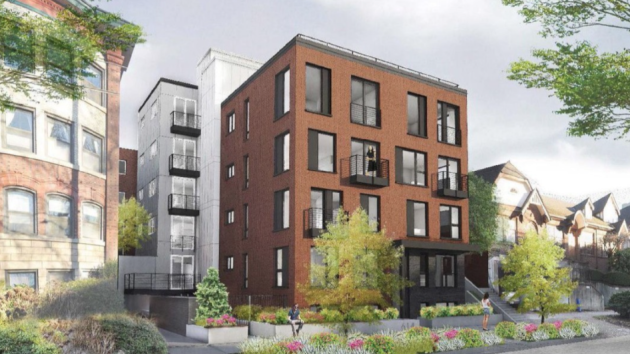
Housing prices have skyrocketed across New Jersey. There is a critical shortage of new homes to keep up with the state’s robust job and population growth. New Jersey’s population passed 9.5 million for the first time ever and the state’s cities are growing at rates not seen since the early 20th century.
New Jersey needs more housing if the state wants to keep long-time residents from being priced out and meet the demand for families who want to move here. One of the easiest ways to do that is to lower costs by making mid-rise apartment buildings easier to build.

Single-stair reform is a proven remedy that lowers the cost of constructing new housing and advances more affordable and diverse housing options. Even better, it can improve our streetscapes and make our towns more walkable in the process. It works by providing flexibility to design new apartment buildings without redundant staircases, while encouraging and prioritizing other more effective fire safety methods.
What is single-stair reform? Currently, a little-known administrative code requirement in New Jersey requires two stairwells connected by a hallway on each floor in all multi-family buildings above 3 stories, even small buildings with a single apartment per floor. This may seem like a well-intentioned rule, but in reality, this requirement is unusual in other developed countries, is far from innocuous, and has no evidence to back it up.

The two stairwell requirement wastes space, increases costs by hundreds of thousands of dollars per staircase, and crucially does not improve safety in smaller mid-rise buildings that have sprinklers and other modern fire safety measures. In New York, Georgia, Vermont, and nearly every other high-income country across the globe, modern single-staircase buildings have been built for decades. Fire departments have been rescuing residents in these single-staircase buildings just as safely there as here, supported by high fire safety design standards that are geared specifically toward mitigating fire risk in single-stair buildings. In fact, a recent analysis of 12 years of fire data by the Pew Charitable Foundation finds that single-stair buildings in New York City and Seattle had death rates as low or lower than two-stair buildings. Not a single death can be attributed to a building having a single stair in the 12-year study period in research that looked at tens of thousands of modern single-stair buildings.
What’s more, if you’ve ever wondered why new buildings tend to be bulky and monolithic and often lack a ground floor retail space, it turns out that the requirement for a redundant staircase and connecting hallway are big drivers of this. The unnecessary mandate makes it too expensive to build modest-scale housing on smaller lots and forces project developers to build on large, consolidated lots, which often results in more disruption to communities. Moreover, the resulting lack of space for a storefront creates gaps in commercial corridors, discourages walkability, and drives business away. As a result, the lifeless streets caused by mid-rise apartment buildings with multiple stairwells all too often lead to a smaller property tax base, leaving a higher tax burden on residents in older buildings.

Floor Plans for 101 Storm Ave in Jersey City, NJ
-Small lot in McGinley Square with plans for 14 units
-Five-story building with two required stairwells
-Stairwell requirement leads to lost space for housing and retail
There is hope for New Jersey to see the benefits of single-stair building reform in the near future. A4972, introduced by Assemblyman Clinton Calabrese (D-36, Bergen & Passaic) and co-sponsored by Assemblywoman Barbara McCann-Stamato (D-31, Jersey City, Bayonne & Kearny) will help make these benefits a reality by empowering the state’s municipalities with the choice to allow four-to-six-story single-stairway multi-family residential buildings. The standards set out by municipalities may also include upgrades to existing safety regulations such as higher firewall ratings, pressurized or open-air stairwells, better sprinkler systems and shorter distances to the building exit.
Almost all European countries have long allowed single-stair buildings, a key factor in creating cities with some of the most iconic and charming streetscapes in the world.
In the US, cities like New York and Seattle already allow single-stair multi-family buildings up to six stories. Austin, Texas recently passed a similar measure to lower the cost of housing. And Colorado successfully enacted a sweeping single-stair reform that will allow for single-stair buildings of up to five stories in all cities with more than 100,000 residents.
With rising costs across New Jersey, it is critical that Trenton takes this important step towards lowering the costs of building new housing. Please consider writing your legislators to support single-stair reform.