
The Port Authority of New York and New Jersey has had a rough stretch of headlines lately, and PATH riders know it all too well.
From chronic service disruptions like the Hoboken switch failures to crowded commutes that feel more unpredictable than ever, frustration among daily riders has neared a boiling point. At the July 24 Port Authority board meeting, leadership offered a brief apology for ongoing Hoboken track problems. But for many commuters, such efforts may seem perfunctory, especially when these meetings occur in the middle of the working day across the river.
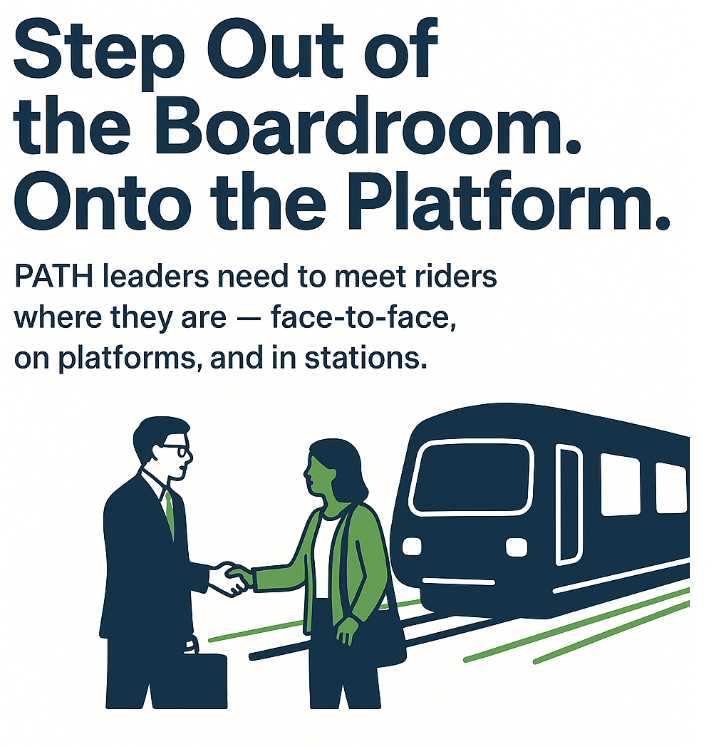
If the Port Authority wants to rebuild public trust, the solution cannot end with polished press releases and formal boardroom updates. Port Authority and PATH leadership must meet riders where they are — on platforms, at stations, and in the flow of daily commutes. Port Authority Chairman Kevin O’Toole, Executive Director Rick Cotton, and PATH General Manager Clarelle DeGraffe need to better understand the conditions causing frustration among the 222,000 riders who rely on PATH to get around New York, Newark, Harrison, Jersey City, and Hoboken. They need to hear our candid feedback on the state of things.


There is some limited precedent for better outreach. During high traffic events such as concerts or sporting events, there are PATH representatives who direct traffic and support on helping commuters identify where to go. Earlier this month, Port Authority Police met with hundreds of riders through tabling at National Night Out events at nine facilities in New York and New Jersey. This was a small but important gesture, one that reminded people that public officials can be accessible and human. But it was also fleeting, a one-off moment rather than part of a consistent effort to listen and respond.
Commuters deserve more than occasional gestures during special events. We deserve to know that PATH leaders are not only aware of their frustrations but are actively engaging with them, face-to-face, to better understand how we rely on the system. Imagine regular “Commuter Office Hours” at key stations, or roving PATH reps who table outside PATH Stations to listen firsthand to rider concerns. Even small-scale, informal interactions could go a long way in bridging the trust gap and understanding rider frustrations.
And these sessions should not be confined to the rush hour commute. PATH representatives should be available during off-peak service and on weekends to see first hand the mounting frustration due to infrequent service levels that result in dangerous crowding conditions on trains and on the platform. It is our hope that by listening to PATH riders, PATH will finally begin to take positive steps to improving service as the system’s ridership recovers with more workers returning to the office.

If PATH leadership meets with riders, they will hear asks that include weekday schedule changes to better reflect the nature of post-pandemic commuting patterns. They will hear from Jersey City residents who want direct weekend service to 33rd Street restored, reducing the travel time caused by the Hoboken detour. PATH leadership can hear first hand about the broken fare gates and pervasive fare dodging at Exchange Place. Residents, tourists, and business travelers alike will tell PATH representatives of their hopes for direct service to Newark Airport. But, most importantly, PATH leadership can explain to riders what they are doing to make the system more reliable.
PATH has a lot that it can learn from peer transit agencies:
Bay Area (BART): General Manager Bob Powers launched in 2021 a “rider listening tour”, visiting top ridership stations to speak directly with commuters on platforms and hear feedback firsthand. BART, notably, is engaging in a replacement of its rolling stock, upgrades to its stations, and an expansion of its rail network.
Chicago (CTA): In 2025, the Chicago Transit Authority (CTA) launched a series of “CTA Chats” pop-up events across various stations. These informal gatherings allowed riders to engage directly with CTA leadership and staff, discussing topics such as service, safety, and improvements.
Toronto (TTC): The Toronto Transit Commission (TTC) in August 2024 invited public feedback through station pop-ups and bus ride-alongs as part of developing its 2025 Annual Service Plan to ensure service changes reflected rider needs and shifting travel patterns.
The Port Authority has shown a willingness to listen to several advocacy groups in recent months (in particular the Better PATH campaign by Hudson County Complete Streets) which is important and commendable. But advocates alone can’t carry the voices of tens of thousands of daily riders. Meeting with commuters directly would not only improve transparency but also signal that the agency is serious about putting riders at the center of its mission.
Public trust is hard to win and easy to lose. For PATH, the path forward may be as simple as stepping onto the platform and listening.

One response to “PATH Leaders Need to Step out of the Boardroom and onto the Platform”
The reality is that there are probably only 120k discrete recurring users out of a total addressable market of 3-5m. So many more people DON’T use PATH than DO or COULD. That’s a demand side problem. Listening just to users isn’t going to reveal all the problems.