
Transit-Oriented Growth and Walkability Go Hand-in-Hand
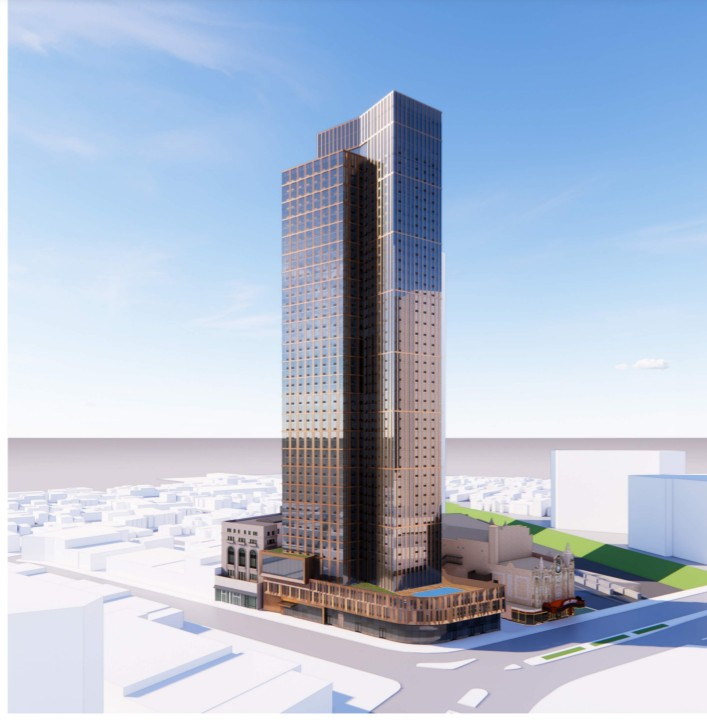
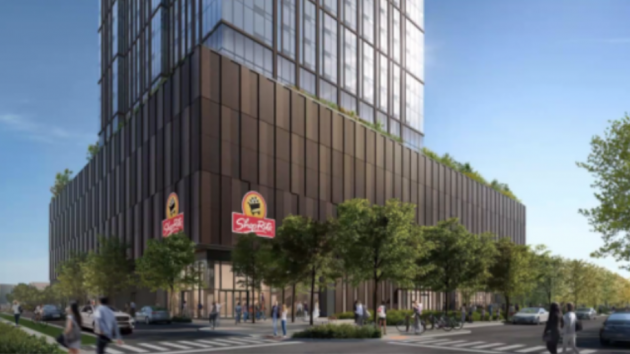
2873 Kennedy Boulevard in Journal Square is slated to be redeveloped into a 54-story mixed-use, mixed-income building with a supermarket on the ground floor. At roughly 50,000 square feet, the supermarket would be a bit larger than the Target opening at 10 Journal Square across the street, and roughly 5 to 10 times as large as a typical urban C-Town or KeyFood store.

Notably, the supermarket (and the building it’s in) do not include a parking lot or garage. This is significant because no supermarket this large has been built in Jersey City without parking. In the past, large national retailers including Trader Joe’s have been reluctant to build stores without parking in Jersey City, due to a belief that there weren’t enough potential customers within walking or transit distance to sustain business. In fact, the Whole Foods that opened downtown a couple years ago is built at the bottom of a parking garage. Three other large supermarkets under construction in Jersey City (the new ShopRite that will replace the current MetroPlaza locale, the Target under the 10 Journal Square towers, and the unnamed supermarket at 55 Hudson Street) are all being built with customer parking.
What is different now in Journal Square (in contrast to downtown), perhaps, is that thousands of apartments have been built or proposed in Journal Square without parking, at densities far exceeding what is allowed Downtown. This has created an inbuilt customer base for walkable retail that may well lead to an explosion in walkability in coming years. Residents without cars are residents who shop local rather than driving to big-box stores.
What is going on is the opposite of this famous graphic of the vicious cycle of car dependency; Journal Square is one of the few examples of the cycle working in reverse in the 21st-century USA:

The new project would provide at least 82 income-restricted apartments, as well as a $3 million contribution to the Jersey City Redevelopment Agency to fund public space improvements around Journal Square. Overall there would be 824 apartments.

The lack of parking means that almost the entire street-facing frontage will be activated. This sort of street activation is known to make walking more pleasant and improve public safety. If the project had a parking garage, a large part of the street frontage would be taken up by a curb cut that would cause conflicts with pedestrians, as well as dead street frontage for the garage itself.

Journal Square is building denser transit-oriented development than anywhere else in the country, while minimizing car dependency and encouraging walking and biking in a way not seen anywhere in the US outside Manhattan due to elimination of parking requirements for even the largest new buildings.
Journal Square’s transformation toward car-free living is so dramatic that it is starting to be reflected in citywide data. For instance, the Census American Community Survey shows that the percentage of Jersey City Residents without a car has reached new highs in recent years–car-free households have increased by 65% since 2011 and now make up almost 44% of households in all of Jersey City for the first time in the 21st century:

Perhaps we should be thinking about similar approaches to development downtown to mitigate the risks of traffic congestion and help retain retail walkability at a time when brick-and-mortar stores are under siege from ecommerce nationwide. After all, downtown Jersey City along the waterfront has even better infrastructure for transit-oriented growth that prioritizes walking and biking than Journal Square, due to its three PATH stations and Hudson-Bergen Light Rail access.

3 responses to “New Supermarket Coming To Journal Square:”
This is great but there are no green spaces in journal square and the transit options are very mediocre outside of PATH. This also looks like mostly luxury housing so will likely price out locals.
Agreed. They are including 3 street trees on the JFK side, and 0 on Magnolia, which is abysmal. Plants are in planters which sooner or later die and just look ugly. Look at 3 Journal Square.
[…] The project at 2873 John F. Kennedy Blvd. would also include more than 800 residential units with at least 82 income-restricted units. Additionally, the project would incorporate 50,000 square feet of retail spread across the first and second floors, Better Blocks New Jersey noted. […]