
And is it the most efficient and effective way to create affordable housing?
In Jersey City, there is broad agreement that income-restricted affordable housing is a good thing that is in short supply. Where things get thorny is determining how to get more built. Recently, mayoral candidate and current Ward E Councilman James Solomon has put out a series of videos about “stopping all-luxury development” and forcing developers to put affordable housing in every new building within the city’s redevelopment areas. What he has not highlighted is that his plan relies on what he calls “city financing tools,” which are payments-in-lieu of taxes (PILOTs) and redevelopment area bonds (RABs).
PILOTs are long-term tax abatements that can subsidize affordable housing development by foregoing some of the property tax revenue that the city would otherwise get if the project received no PILOT. There are many misconceptions about how PILOTs work. Developers still have to pay the city under a PILOT agreement so the city still collects revenue from developers. Typically payments to the city under a PILOT are a percentage of building income rather than a tax assessed on the value of the land. The difference between the PILOT and the property tax can be thought of as “the value” that both the city and the developer get from the PILOT. RABs are city-issued bonds used to fund project construction costs, and the city pays interest on those bonds (which are secured by payments to the city from the developer through the PILOT agreement).
While only one market-rate project and four mixed-income projects in the past 8 years have received a tax abatement in Jersey City, the Solomon plan would require a tax abatement for every single project where it would mandate inclusionary housing under current market conditions, drastically increasing the number of abatements citywide.
So what is the fiscal impact of this proposal?
A recent PILOT application for a building at 177 Grand Street sheds light on this question, and provides a useful metric for calculating the cost of increases to the amount of affordable housing new projects must include. Typically we don’t get to peer into the finances of new developments in Jersey City, but in the case of 177 Grand Street, the city brought in an independent auditor to look at their books; this gives us a unique opportunity to examine the financing of Jersey City development. Using conservative estimates, our conclusion is that, in the long run, the PILOTs required for a universal inclusionary zoning program to produce about 750 affordable units per year would cost city taxpayers over $184 million per year in tax revenues that it would otherwise receive from development, under current market conditions. Given the combined city and school property tax levies collect around $830 million in revenue per year, using PILOTs to fund an inclusionary zoning mandate would necessitate property tax increases on non-abated properties (or cuts to city services) of well over 20% compared to what we’d see if the plan were not implemented over the long term, as we explain below.
Outline
- Section 1: Using public records, we show how a recent 15% affordable project needed a subsidy from city taxpayers of over $240,000 per affordable unit.
- Section 2: We explain how we arrived at the $180 million+ per year estimate for lost tax revenues based on this figure.
- Section 3: We explain why the alternative of simply mandating the affordable housing while not giving tax breaks would lead to no affordable housing being built, accelerate development in lower-density neighborhoods farther from transit, and cause higher rents, reduced services, and higher taxes in the long run.
- Section 4: We explain why the promise of $1,000 per month rents is especially hollow.
- Section 5: We lay out better ways that the city can actually build affordable housing.
1. The Case of 177 Grand Street
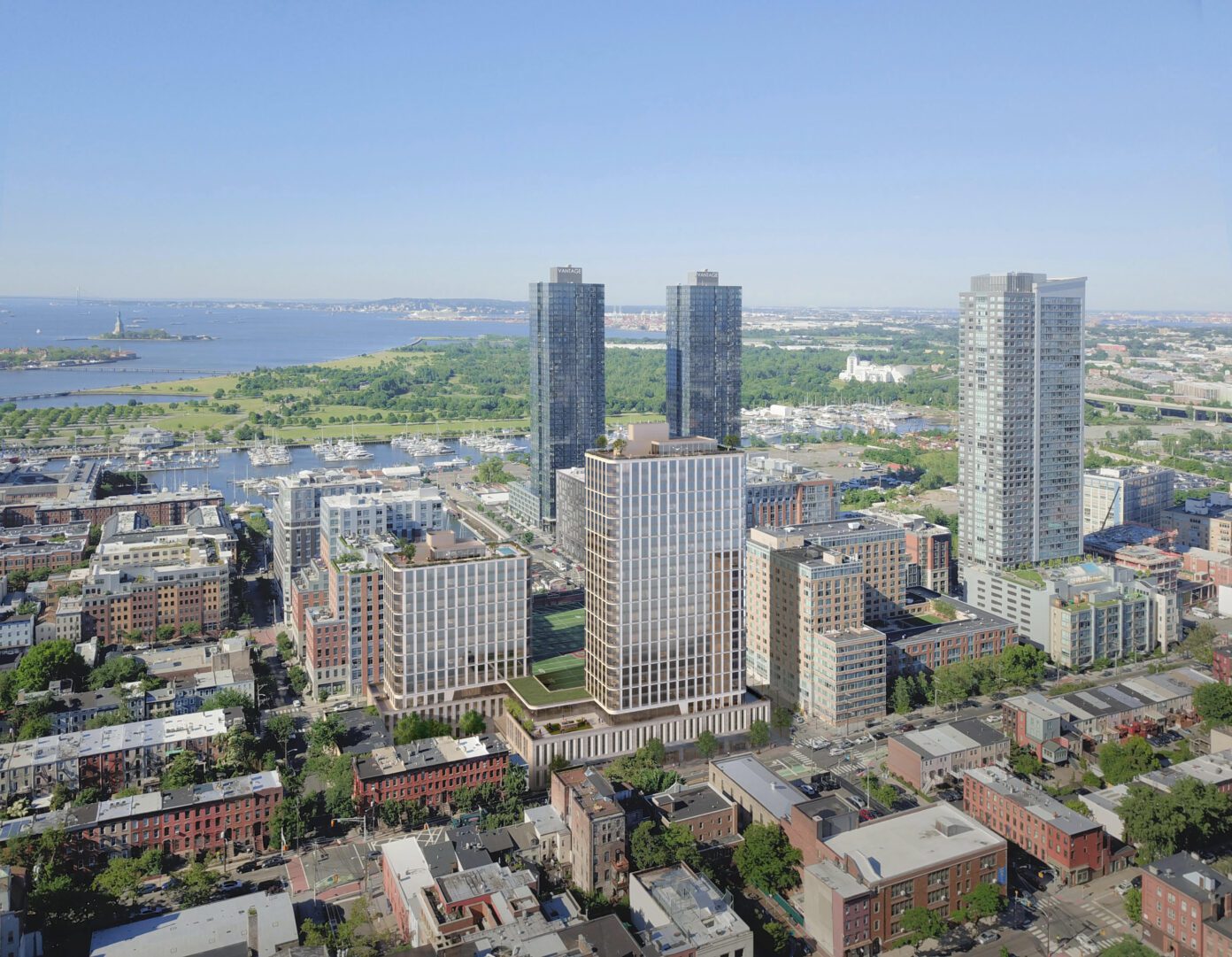
177 Grand Street is a 413-unit proposal in the Paulus Hook neighborhood of Jersey City. Due to the Inclusionary Zoning Ordinance (IZO) passed in 2021, if a Downtown Jersey City project receives an upzoning or substantial variance, 15% of the units must be set aside as income-restricted units [1]. Before the IZO, the inclusionary set-aside was negotiated on a per-project basis and was often lower; Solomon pushed the city to impose a much higher, inflexible requirement Downtown. Despite the lower set-aside before the IZO, hundreds of inclusionary units were produced under the older, more flexible rules. Ever since the IZO set in place a rigid 15% requirement, zero inclusionary units have broken ground downtown under the 15% set-aside [2].
What 177 Grand St reveals is that this is not a coincidence–the new 15% set-aside makes mixed-income projects Downtown financially infeasible.
Silverman (the owner of 177 Grand St) came before the Council requesting a PILOT. They claimed that the project is not financially viable without a PILOT due principally to the 62 required inclusionary units required under the IZO. Is this another case of greedy developers trying to scam the public? Well, the city hired an independent financial consultant, NW Financial, to examine their claims. NW Financial’s conclusion is that, indeed, the project is not viable without a PILOT. The following is an excerpt from their report [3]:

[Quick note to readers – IRR is the internal rate of return (a metric investors use to compare investment opportunities) and YOC is the yield on cost (which measures a project’s income as it relates to the project’s costs).]
In plain English, the analysis concludes that 177 Grand is not profitable enough to materialize without the PILOT. The 15% IZO depressed the property income so much that the developer would not be able to secure a permanent loan needed to enable construction. When the average person wants a bank loan to buy a house, the bank would verify their income and liabilities to determine the borrower’s risk and ability to repay the mortgage. Similarly, banks want 177 Grand to have an annual property income equal to 1.2x the annual loan payment. However, the 15% IZO requirement pushed the income below that threshold, so the project could not secure the necessary mortgage without a PILOT.
NW Financial’s analysis establishes that a PILOT is required for the project to break ground and deliver the 62 inclusionary units. The next (and central) question is: how much subsidy does the public need to provide to make these affordable units financially viable? NW Financial produced this chart, showing how much Silverman would pay in PILOTs versus how much Silverman would pay in conventional property taxes (if this table intimidates you, you can skip to our explanation right below the image):

The bottom row of the “Gross PILOT” column, tells us that Silverman would pay the city $106 million in PILOT payments over 30 years, while the bottom of the “Conventional Taxes” column tells us that without a PILOT, Silverman would pay a total of $142 million in property taxes, a $36 million difference. If we were to divide $36 million by 62, we would arrive at a public subsidy of over $581,000 per affordable unit. But this computation unfairly overstates the size of the subsidy. For one, a dollar invested or used today is worth far more than if you were given a dollar 30 years in the future. This is a concept known as the net present value [4]. Basically, accountants use something called the “discount rate” to compute net present value. The discount rate is often selected by determining an entity’s cost of capital; in this case, since the city is a government entity, the 10-year Treasury rate is an appropriate choice. At the time of writing, this rate was 4.139%. When we plug in our discount rate into the net present value formula [5], we get a net present value for the subsidy of $21,903,167, or $353,297 per affordable unit.
There is one other wrinkle, however. Not all of the cost of that subsidy will end up being borne by city taxpayers. According to the latest city budget [6], 81.6% of a property’s tax levy goes to various city entities (municipal government, schools, libraries, the arts fund, etc), while 18.4% goes to county entities. In contrast, only 5% of the PILOT revenues go to the county. So we have a 13.4% gap in county taxes under the PILOT scenario. This 18.4% figure can be deduced from the chart below.

In a sense, this means that the city gets a bit of a free ride from the county, making the PILOT subsidy somewhat less costly to the city. However, of the county’s $453 million tax levy [7], $196 million (or 43.2%) is paid for by Jersey City taxpayers (see the chart below). So even though Jersey City is “cutting” the county out of its full share of property tax revenue on the development, the county still needs revenue so they turn around and raise their portion of the property tax bill on all the other tax payers. Thus, a PILOT that attempts to cut out the county is still 43% “paid for” by Jersey City anyway. It’s like your spouse treating you to dinner by paying with your joint credit card – half of it is still your money!

If we look at the change in direct city revenues due to the PILOT, we get an net present value figure for the direct city subsidy of $164,274 per affordable unit. A similar calculation for the county shortfall gives us a county share of $189,003 per affordable unit. Assigning 43.2% of this shortfall to city taxpayers, we get:
  ($164,274 city shortfall per affordable unit)
+ (43.2% county share paid by city)
× ($189,003 county shortfall / affordable unit)

= $245,829 city taxpayer shortfall per affordable unit.
The calculations that led to the net present value figures presented here are available here [8] for review.
2. What Would A Fully-Funded Universal IZ Mandate Cost?
We can estimate how much a universal 15% mandate would cost using these numbers. But first we want to emphasize that the estimates below are quite conservative in several ways:
- Councilman Solomon is proposing a universal 20% mandate, which would be even costlier than the 15% mandate he championed for downtown, both per affordable unit and overall (though federal and state subsidies would be available for some–not all–of the buildings, as we explain in section 5).
- 177 Grand Street is a project in one of the city’s highest-rent neighborhoods. It takes a much smaller subsidy to make a Paulus Hook project viable than a project in Journal Square, or one on the West Side.
- 177 Grand St is also what is called a “soft site.” The Grand Street property was a collection of vacant lots and one-story buildings when it was bought. When intensive uses already exist on a site, larger subsidies are required to make demolition and redevelopment feasible. This is especially a problem in Journal Square, where many of the new buildings have been built (or would be built) in place of uses such as parking garages and multi-story office buildings.
Regardless, we can use the per-unit subsidy figure we compute as a conservative floor on total cost.
In a recent video interview, Solomon suggests that all buildings over 50 units would be covered by his proposal. Using publicly available data from the city’s permitting portal [9], we have compiled a list [10] of every new-construction building permit issued in Jersey City since 2015. This list tells us that Jersey City has produced 10,915 units in buildings with more than 50 apartments over the past two years. To be conservative, let’s round this figure down to 5,000 units per year in developments covered by the universal inclusionary zoning law. A 15% IZO would therefore produce 750 affordable units per year. If the $245,829 figure per affordable unit is correct, in the long run, at present housing production levels, the subsidy would amount to over $184 million in foregone property tax revenues per year.
By comparison, the city/school combined tax levy is $824 million per year. This means that, in the long run, to maintain current housing production levels and build 750 affordable units per year, property taxes on current properties would have to be about 22% higher than they would without this policy in place. Such a tax increase would be necessary to keep all levels of local government properly funded due to the massive subsidy required to support such a high percentage of affordable housing in every large new building. The other alternative is to wait for market rate rents to rise to make new development projects viable. But such an increase isn’t limited to just new buildings – market rents would rise in older properties too, breaking Solomon’s promise to limit annual rental increases.. In short, subsidies and rent increases would need to be even higher at a 20% set-aside, though some limited state and federal financing might become available to partially offset the costs, as we explain later in Section 4.
3. Alternative: Don’t fund Inclusionary Zoning; “Make Developers Pay!”
Could one solution to this conundrum be to not provide a substantial subsidy for the cost of the affordable housing–presumably forcing developers to pay the difference? This might sound particularly appealing to politicians pandering for votes; a politician can promise to give people thousand-dollar apartments, all while (supposedly) not forcing the cost onto their voting constituents. And hey, if it doesn’t work out, at least it will stop development, which is a victory for donor-rich constituencies like neighborhood associations that oppose new housing – even if it means less wealthy renters are forced out. But are these suppositions true?
First up: would this plan would produce affordable apartments? Under New Jersey’s Municipal Land Use Law [11], development applications that were filed with the city before any changes to the IZO were passed are grandfathered under the old rules, from the time of application, until at least five years after approval [12][13], and as long as 10 years after approval. An underfunded inclusionary zoning plan would cause a rush of applications by developers looking to “beat the buzzer” and get any 100% market-rate developments grandfathered in. If the argument is that affordable apartments are in dire need now, then a plan that won’t produce many affordable units for a decade or more is a spectacular policy failure.
In the long run, the docket of grandfathered development applications would run out. But that wouldn’t solve the issue of the financing gaps illustrated by the 177 Grand Street example. Housing production would still tank in areas where the mandate applied without subsidies. Sounds good for constituents who don’t want new buildings in their neighborhoods, so what’s the issue? There are four main problems with this:
- It would increase development in lower-density neighborhoods farther from transit. An inclusionary zoning mandate cannot legally be imposed without some kind of compensatory benefit such as a PILOT [14 (see page 7)]. The city could try to underfund the PILOT, but it couldn’t decide to provide no PILOT at all. The distinction matters because long-term tax breaks – even small ones that do not make projects viable – can only be issued in areas in need of redevelopment. Most of Jersey City’s “residential neighborhoods” fall outside of these redevelopment areas (except around Downtown, Journal Square, and Lafayette). And because the city cannot offer tax breaks to projects outside of redevelopment areas, they cannot legally impose inclusionary mandates there. Therefore, these outer neighborhoods would become more attractive targets for developers seeking to avoid onerous requirements that make it impossible to afford to build in more central areas. Research in Seattle showed that when a city offers undersized incentives in exchange for inclusionary zoning mandates, there is a surge in development in the areas just outside the inclusionary zoning area. This suggests that an underfunded PILOT program would cause a surge in development in these outer neighborhoods that are exempt.
- Jersey City’s budget relies on growth in the coming years. Jersey City’s budget faces a dire structural deficit resulting from state aid cuts and growing pension obligations. Expanding the tax base is the only way to spread around the pain of ever-increasing tax levies. If Jersey City doesn’t grow its tax base, the city will face a fiscal death-spiral. This is an admittedly dramatic term for a very real danger in which more and more government spending is paid for by fewer and fewer residents, resulting in either untenable tax increases, increased city debt, or both. Eventually, if this is not corrected and the city continues to borrow money, it can lead to credit downgrades and municipal defaults.
- The plan would increase market-rate rents. The reduction in housing supply will result in increased rents. Multiple independent peer-reviewed studies by academic researchers have shown that increased housing supply decreases displacement and keeps rents down, even in the local vicinity of a new project [15], [16] [17]. Jersey City’s ability to build housing has kept rents lower than they otherwise would be.
- The plan would result in little affordable housing getting built. Since the affordable units are a percentage of total units built, we would still expect to see a disappointing number of affordable units built. Again, going against the rhetoric of the dire need for affordable housing.
The takeaway is that developers will not be the ones paying. Jersey City renters and taxpayers will be paying, and we might not even get much affordable housing for our trouble.
4. Other Considerations: Affordable Housing Trust Fund and $1000 Per Month Rents
Under Jersey City and New Jersey’s affordability standards, only 13% of the affordable apartments produced by inclusionary zoning mandates in Jersey City are required to rent at levels below $1000–and only people making below 30% of Area Median Income are eligible [18][19]. In an interview with local Instagram influencer 7alkaline__ [20], Solomon claimed that he’d fund “buying down” of more apartments to $1,000 per month levels using the city’s Affordable Housing Trust Fund (AHTF). The major problem with this is that 84% of the city’s AHTF funds come from a 1.5% impact fee on 100% market-rate development [21 (see page 6)][22 (see paragraphs 3.a.ix and 4.a.iii)]. A universal city-wide IZO policy would largely eliminate this “all-luxury development” (as Solomon likes to call 100% market-rate housing), thereby eliminating the main pool of funding to buy down rents to $1,000, as well as the Right To Counsel program. To our knowledge, Solomon has not explained how he’d replenish the AHTF to fund $1,000 per month rents.
5. A More Cost-Effective Path to Income-Restricted Housing
So should we throw our hands up in the air and stop building income-restricted housing? No. There are pots of federal and state money that can be leveraged to produce more affordable housing at less subsidy than a universal inclusionary zoning plan. Chief among these funding sources are a state subsidy known as Aspire and a federal subsidy known as Low Income Housing Tax Credits (LIHTC). For years, until the first Bayfront building and 701 Newark Avenue were approved, Jersey City left hundreds of millions of dollars in state and federal subsidies on the table by instituting a de facto 6-year moratorium on PILOTs which are necessary to apply for these grants.1
In New Jersey, LIHTC is administered by a state agency (HMFA) that includes PILOTs as an underwriting requirement for 4% (+bonds) projects and a scoring item for competitive 9% projects. Unless this has changed recently, a 4% LIHTC project using state bond financing or a 9% project cannot secure LIHTC without PILOT. ASPIRE is typically paired with 4% (to close the capital gap) for multifamily projects, so that’s also off the table without a PILOT.
These state subsidies are only available for buildings that are at least 20% income-restricted [23][24], but the kicker is that there are not enough subsidies to fund every new big building in the city with a universal 20% mandate. To get the most “bank for our buck,” the city could require developers seeking a PILOT to provide at least 20% affordable housing to qualify for Aspire and LIHTC funds and eliminate mandates for everyone else. This would keep the pool of PILOT subsidies from being spread too thin while giving an incentive to build affordable housing.
Focusing PILOT subsidies on projects that choose to go with a 20% income-restricted set-aside to leverage these funding sources would give them a better chance of succeeding. At the same time, Jersey City should work to ensure that developments building market-rate supply can proceed without onerous and unfunded affordable housing mandates fixed as an arbitrary percentage of units. This would allow the city to grow its tax base, make new contributions to the Affordable Housing Trust Fund, ease rental pressure on existing housing stock, and fund other priorities like new schools and public spaces.
6. The High Cost of “Affordability”
The worst possible outcome is that the Solomon affordable housing plan will provide neither housing nor affordability; unfortunately, this is also an extremely probable outcome. In the best case scenario, property taxes go up 22% (or city services get cut) to support hundreds of millions of dollars in subsidies to developers to fund his universal 20% inclusionary zoning ordinance. More likely, however, no affordable housing is built under the Solomon plan in the short run, while in the long run, housing development grinds to a halt and rents and taxes rise even more dramatically as new supply dries up. Mandated “affordability” will price out thousands of working and middle-class families to reward a few hundred with a golden ticket to the affordable housing lottery.
Jersey City deserves a mayor who can actually deliver, not just make promises that fall apart under scrutiny. Look to mayoral candidates who know how to strategically use PILOTs to unlock state support instead because Jersey City cannot afford to elect Mayor Solomon.
- The moratorium is in reference to the mayor and council refusing to give out PILOTs for any reason between 2017 and 2024 because they became gun-shy after public backlash to PILOTs issued by the Healy administration and in the first half of Fulop’s time as mayor. ↩︎
3 responses to “Can Jersey City Afford Affordable Housing In Every New Building?”
[…] Read More: 177 Grand Street and the Cost of Affordable Housing […]
[…] The True Cost of Affordable Housing: 177 Grand Street PILOT […]
[…] Read More: Can Jersey City Afford Affordable Housing in Every New Building? […]