

This Monday and Tuesday, the Jersey City Department of Infrastructure will be hosting transportation workshops in the West Side and Journal Square that will inform the city’s transportation master plan.
On Monday the workshop will be at the Hank Gallo Community Center in Lincoln Park. On Tuesday it will be at 161 Newkirk St (HCCC Culinary Arts School) near Journal Square. Both will be between 3pm and 7pm, with a presentation between 7pm and 8pm. There will be an open house between 3pm and 7pm.
Below is a wish list of changes that we hope residents who can attend will advocate for:
Bus Rapid Transit and Bus Priority After many years of false starts, momentum is finally building for bus rapid transit (BRT) along Kennedy Blvd. We’d like people to advocate for bus rapid transit, but also interim bus priority measures to speed buses through along busy bus corridors (like Kennedy Blvd, Bergen Ave, Communipaw Ave, Montgomery Ave, Pavonia Ave, and Central Ave), namely traffic signal priority for buses [1]. One example of traffic signal priority is holding green lights for approaching buses, or changing lights to green early if a bus is detected at an intersection. Buses can also be allowed to stop closer to the intersection than cars, giving them a head start. Since buses can hold many more people than cars, giving priority to transit has great benefits in terms of throughput.

Bus Stop Consolidation. One other measure that we hope people will advocate for us bus stop consolidation. TransitCenter notes that “America’s bus stops are too close together … given that buses spend 20% of their time at stops, reducing the overall number of stops can dramatically speed trips for riders.” Furthermore, “Through better bus stop spacing — also known as bus stop balancing or bus stop consolidation — agencies [including San Francisco’s and Portland’s] have improved bus speeds between 4 and 14 percent” [2]. Bus advocates in Jersey City estimate that consolidating stops along JFK which alone would speed up buses by 10 to 20%.

Street Safety Improvements. By discouraging walking and cycling, the lack of safe routes for pedestrians and cyclists induces demand for driving and traffic congestion in the long run, as well as endangering the most vulnerable road users. While Jersey City has made progress in implementing protected bike lanes, hardened daylighting at intersections, stop signs, speed bumps, and road diets, much more needs to be done on this front. This year, two pedestrians were killed by left-turning vehicles in Jersey City, so we also ask our readers to advocate for left-turn calming which involves hardened centerlines that slow down turning vehicles [3]. Leading Pedestrian Intervals at crosswalks, giving pedestrians a 3-7-second head start would also help reduce left-turn crashes by about 13% [4]. We ask readers in Journal Square and the West Side to think about places along their daily routes where they feel uncomfortable or unsafe on foot or on bikes, and share your input with the Department of Infrastructure.

Fill In The Gaps In the Citi Bike Network. In June 2025 (the most recent month with data available), Citi Bike riders took over 97,000 rides in Jersey City and Hoboken [5]. That is over 3,200 trips per day. Many of those riders would otherwise have driven or taken taxi/carshare vehicles for those trips, so Citibike is an essential method to reduce congestion and improve traffic safety. In many parts of Jersey City, however, especially on the West Side and around the Heights, the usefulness and ridership of Citi Bike are limited by the large spacing in between Citi Bike stations. We ask our readers to advocate for more Citi Bike stations around the West Side, Bergen Square, and Marion.

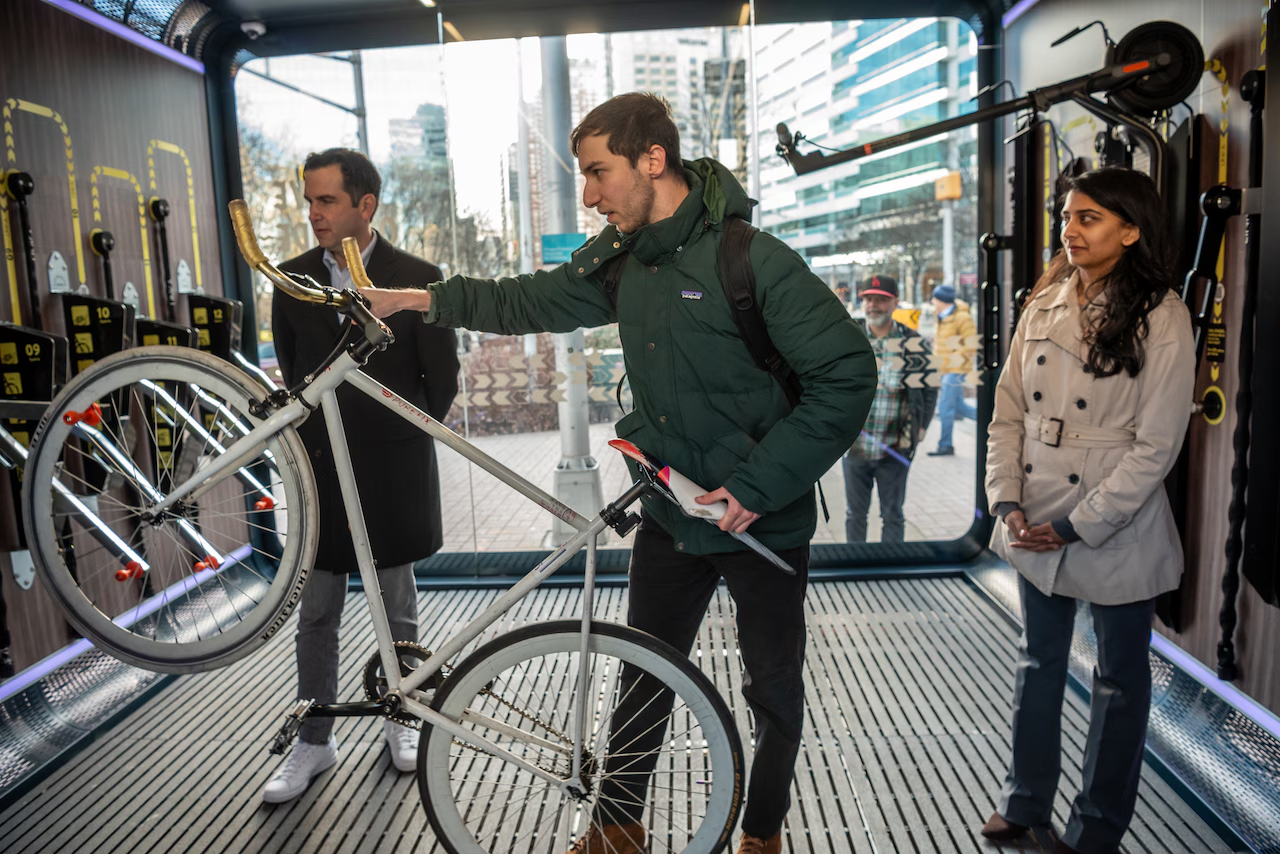
Bike Parking & Racks. Another limiting factor in bike adoption is the lack of safe and convenient places to park bikes. We would like to see more covered and secure bike parking such as Oonee pods, as well as more bike racks on sidewalks throughout the city especially on retail corridors like JFK and West Side Avenue.
More Loading Zones. With the rise of online commerce and delivery apps, Jersey City has seen a rise in delivery trucks that are double-parked or obstructing bike lanes. These illegally parked vehicles not only cause congestion, but also create extremely hazardous conditions for pedestrians and cyclists. Loading zones, especially in areas with many high-density apartment buildings, are a solution to this problem.
School Streets. In New York City and many other cities around the world, laws are in place that allow any school (from pre-K to university level) limit vehicle traffic on the street in front of or near the building by applying to the city Transportation Department [6]. During school arrival and dismissal, school streets keep children safe and help organize traffic from caregivers picking up and dropping off children. At other times, school streets provide an opportunity for kids to enjoy limited space in a crowded urban environment. As OpenPlans notes: “Some schools open the street just during hectic arrival and dismissal times; others use the space to host recess, physical education, or outdoor learning; it can even be used after school for neighborhood events and assemblies. No matter the format, school streets are a powerful tool for communities. They reimagine a roadway to prioritize safety and health; a space for children to play, learn, and grow.”
20 Mile Per Hour Speed Limit. We urge the city to reduce the speed limit on local streets from 25 miles per hour to 20 miles per hour. According to the Canadian Association of Road Safety Professionals, 4 out of 10 of pedestrians die from collisions at 40kph (25mph), while only 1 out of 10 die from collisions at 30kph (19 mph).