
Update February 15, 2026: Since this article was written, the director of the Division of City Planning has determined that the application was not substantially complete as of the date that the new zoning for the site became effective. The landowner of the site has not, to our knowledge, responded to these allegations.
City Virtually Obligated To Approve Plan Under State Law–Despite Performative Downzoning By City Council
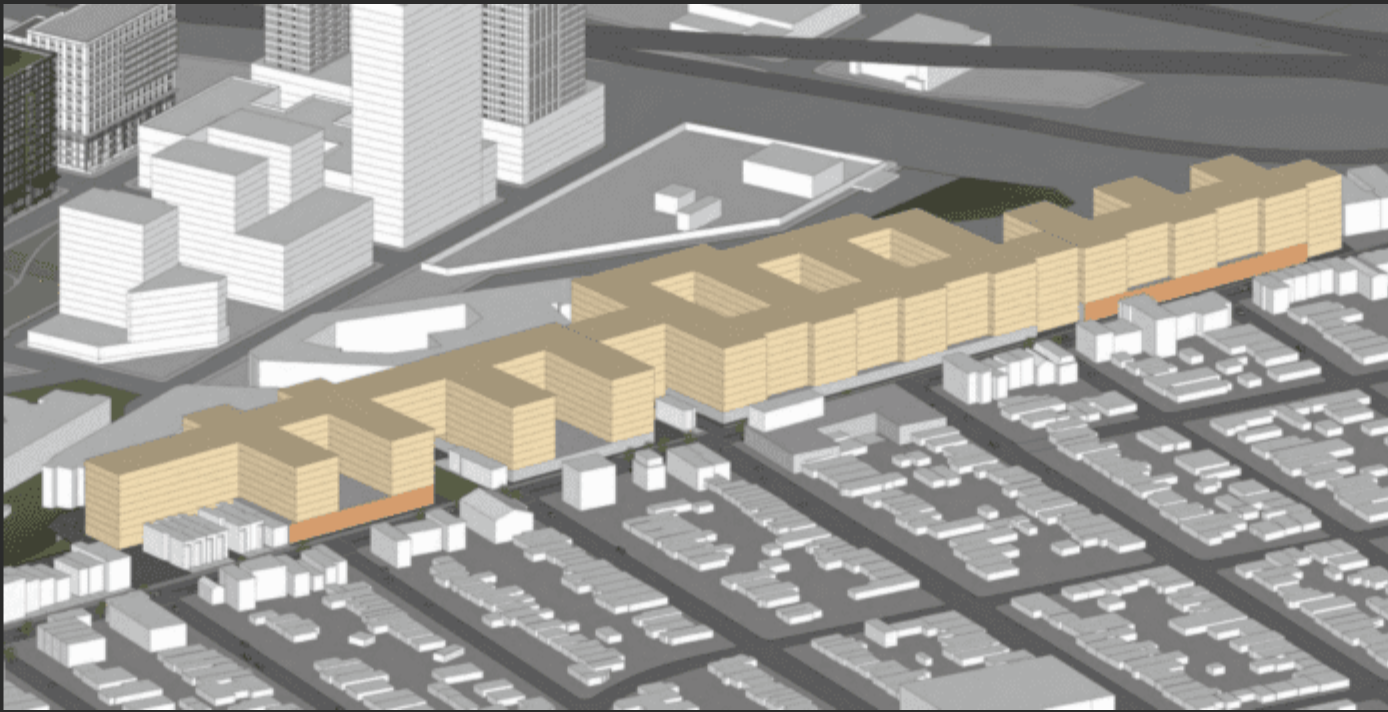
The owner of the land under the former Christ Hospital in the Jersey City Heights filed plans for a mix of 2,233 market-rate senior housing and assisted living units in seven 10-story buildings on December 29. The plans fully conform with zoning rules in terms of height, density, bulk, and use, though the applicant is applying for a payment in lieu of 38 required street trees [link]. Under NJ case law, the Jersey City Planning Board is ultimately required to approve plans that fully conform to zoning [link1, link2, link3]. The plan also calls for 2,202 square feet of retail, 7,741 square feet of office space, and 875 parking spaces.

Back on December 10, the politicians in Jersey City’s Municipal Council chamber were in a self-congratulatory mood as they adopted an ordinance spearheaded by Councilmembers Rich Boggiano and James Solomon. The ordinance banned senior housing and assisted living facilities on all land zoned under the “M – Medical” district citywide [link]. “Passing this ordinance makes it clear that they can’t build luxury-only housing […] and we will guarantee and make sure that there’s real acute care that is on that site,” mayor-elect James Solomon said at the time. “This body has a duty to ensure sufficient health care services for the residents of Jersey City,” he continued, even though the ordinance contained no stipulations, mandates, funding, or even ideas that would have helped keep the hospital open [link].
However, under New Jersey Municipal Land Use Law, any application for development is grandfathered under the zoning rules that existed when the development was first submitted [link]. Despite their pronouncements, councilmembers were well aware of this fact when the ordinance was passed in December. While the Council voted on December 10, ordinances do not come into force until 20 days after approval, so the old zoning rules apply [link]. Councilmembers were also advised by the professional planning staff of the Planning Division that their proposal violated sound planning principles and could put the city in legal jeopardy: During a Nov. 25 planning board meeting, Jersey City Planning Director Tanya Marione warned that “the 2020 master plan really considered the fact that residential should be mixed with these medical uses and the way to do it was not to remove the uses from those areas but to encourage them to be developed together.” The Planning Director has also noted that senior housing and assisted living facilities are classed as inherently beneficial uses under NJ state law; this could create even more legal trouble for the city, potentially exposing the city to substantial legal fees [link, link].
To sum up: the Boggiano-Solomon senior housing ban did nothing to stop the Christ Hospital landowner from filing this 2,200-unit application (which Jersey City is virtually obligated to approve). It did nothing to help keep Christ Hospital open. However, it did make it harder for assisted living facilities to be built elsewhere in Jersey City. Despite its name, the “M – Medical” district covers some land that is not used for hospitals but is suitable for senior housing. At 259 Van Nostrand Avenue in the Greenville section of Jersey City, there is a 67-unit senior housing complex called Harwood Pavilion. All of its units are restricted to seniors making below 60% of area median income [link]. Harwood Pavilion conformed to the senior-housing provisions that the council removed from the “M – Medical” district. While Solomon railed against “all-luxury development” at the December 10 council meeting, under the amendment even low-income senior housing complexes like Harwood Pavilion can no longer be built. Several parcels adjacent to Harwood Pavilion are within the “M – Medical” district, and now are barred from becoming senior housing due to the unanimous actions of the city council in December.

The city’s professional planning staff put out a proposal that would’ve continued to allow mixed-income senior housing as well as low-density mixed-income housing on these non-hospital sites in the M-Medical districts, but the council rejected this alternative. Yet even this alternative-while preventing collateral damage on non-hospital sites-would still leave the question of how to fund Christ Hospital and keep it open mostly unanswered. Similar questions are being asked (and answered) by Jersey City Medical Center downtown, which is hoping to sell parking lots in order to fund an expansion [link]. That proposal, which would boost city government coffers by $27 million as well as giving $27 million to JCMC for its expansion, involves sale of the parking lot land for apartments. The fate of the JCMC deal–and Christ Hospital–will now be in the hands of the incoming mayor. Fresh ideas and political courage are needed to present realistic plans to save and fund Christ Hospital.

One response to “Plans for 2,233 Senior Housing Units Officially Filed For Christ Hospital Site”
This is very interesting. Thank you for the hard work you put into this and looking forward to hearing more about the JCMC expansion.