
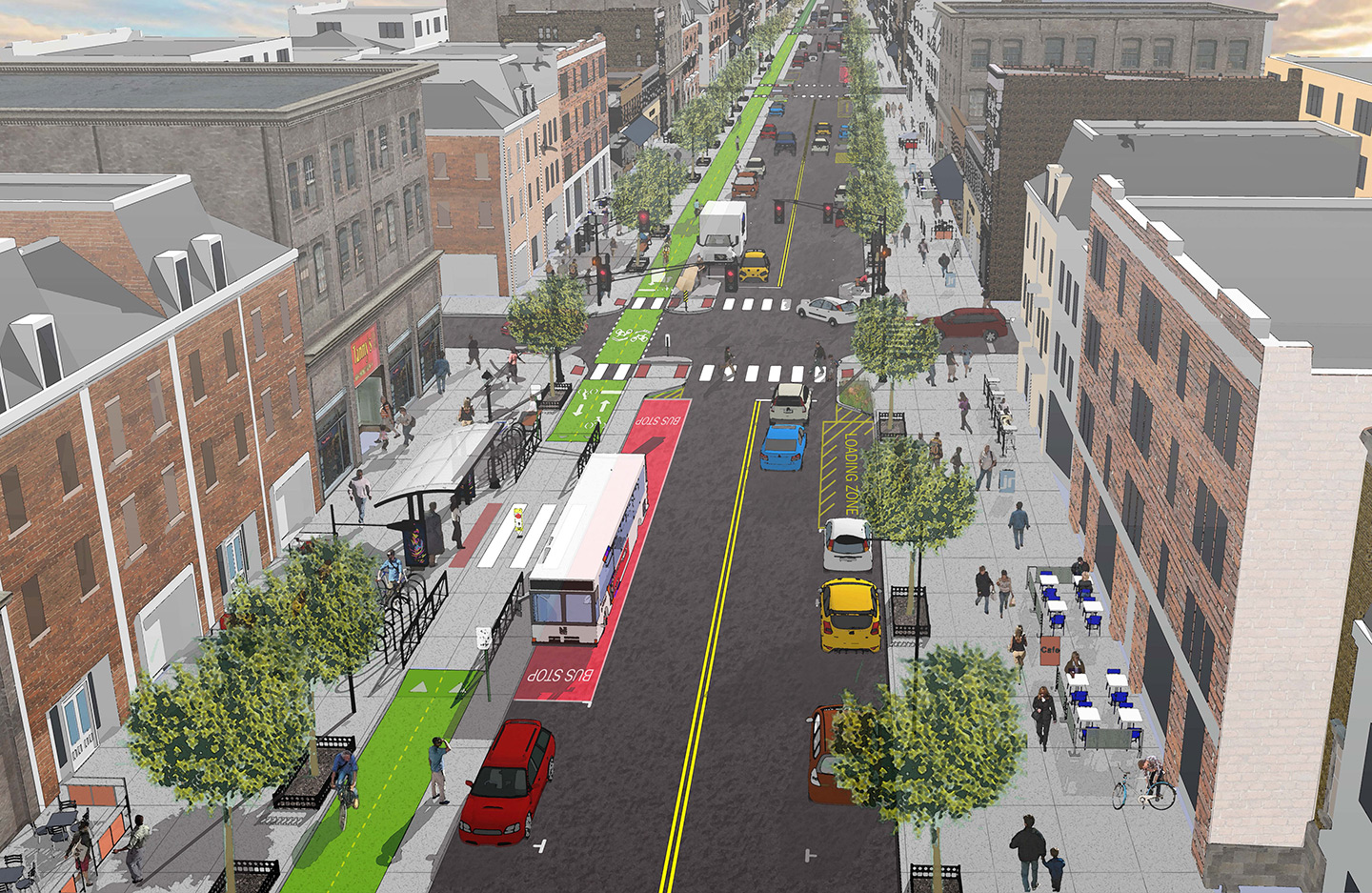
The pushback from businesses on measures to implement walkable, car-free, and car-lite “Complete Streets” policies in downtown commercial districts, is often passionate and sustained. Businesses and critics lament that these measures will hurt local businesses.
This has played out in Jersey City and Hoboken, which have each implemented Complete Streets policies in major commercial corridors. Despite the success of both projects, opposition to these projects was loud. While the Newark Avenue Pedestrian Plaza and the Washington Street Redesign have both been praised, there was significant pushback from residents and business owners at the outset of these projects.[1]


The question that this article sets out to address is: to what extent does implementing walkability measures impact the success of local retail businesses? Specifically, does reduced vehicle access and parking convenience hurt businesses?
The term “walkability” is used here as a stand-in for the concepts and design elements recommended by Complete Streets. Walkability encompasses a range of design and policy elements that make urban spaces safer, more comfortable, and more welcoming to pedestrians and cyclists. Core features include narrower traffic lanes with traffic calming measures, safer intersections, curb extensions and median refuges, protected bike lanes, wider sidewalks, street trees, public seating, and improved lighting. Collectively, the goals of these policies are to reduce vehicular dominance, enhance safety, and create an environment where people feel encouraged to walk, linger, and explore local retail options.
This article focuses on the effects of those policies that reduce, relocate, or eliminate available parking spaces, or which remove or restrict vehicle access to certain streets, specifically when implemented in downtown, commercial districts. The most common complaints heard from detractors include:
- Customers in vehicles will shop elsewhere if they cannot find parking easily
- Double parking provides essential short‑term access for customers completing quick transactions (ignoring N.J.S.A. 39:4-138(m) which makes double parking illegal statewide)
- Delivery and logistics become challenging or impossible if trucks cannot find convenient parking
These objections, while understandable, often stem more from perception and fear than from empirical evidence of outcomes in comparable neighborhoods. In reality, the benefits of creating pedestrian-friendly retail neighborhoods far outweigh any detriments to businesses, municipalities, and citizens. Even if some of the negative impacts feared by business owners are legitimate, there are ways to mitigate those challenges.
The Economic Benefits of Pedestrian-Friendly Design
Evidence strongly supports the idea that walkable neighborhoods perform better economically. “As the number of environmental features that facilitate walkability and attract pedestrians increase, so do office, residential, and retail rents, retail revenues, and for-sale residential values,” a Brookings Institute study found.
Walking activity increases random encounters with stores and increases retail activity overall. In a study commission by the Heart Foundation, Dr. Rodney Tolley found that streetscape improvements supporting walking and cycling increased property values, rents, attracted new businesses, and boosted local economic activity. Bicycle parking, in particular, often produces higher levels of retail spend per square foot than the same space devoted to car parking, reflecting the greater frequency and cumulative purchasing power of cyclists and pedestrians.
The New York City Department of Transportation (NYCDOT) has integrated economic vitality indicators—such as sales tax receipts, commercial vacancy rates, and foot traffic—into evaluations of street redesigns. As set forth in Measuring the Street: New Metrics for 21st Century Streets, NYC’s metrics demonstrate the tangible impact of walkable design:

- Bike paths on 8th and 9th Avenues in Manhattan increased local retail sales up to 49%, compared to 3% borough wide.
- Converting underused parking lots into public parks on Pearl Street (Brooklyn) increased nearby retail sales volumes by 172%, versus 18% borough wide.
- Converting curb lanes into public seating on Pearl Street (Manhattan) increased sales volumes at adjacent businesses by 14%.
- Expanding walking facilities in Union Square North reduced commercial vacancies by 49%, while borough-wide vacancies increased 5%.
- Bus and bike lane development on First and Second Avenues reduced commercial vacancy rates 47%, compared with 2% borough wide.
These cases illustrate a common pattern: access via walking, cycling, and public transit is more economically valuable than the same space used for vehicle parking. Surveys in New York City confirmed that a minority of shoppers drive to these streets, and that pedestrians who valued wider sidewalks over parking spent five times as much money in aggregate as those prioritizing parking. Brookings Institute research further underscores the commercial impact: highly walkable areas generate $6.92 per square foot higher retail rents and 80% more in retail sales compared to areas with only fair walkability.
International studies reinforce these findings. Most notably, studies conducted in several Spanish cities found that pedestrianization increases retail stores’ sales volumes. More specifically, pedestrianization transforms shopping from a goal-oriented activity—drive to the store, buy, and leave—into an experience-oriented activity, encouraging people to linger, socialize, and explore.
Even in cities with more car-dependent cultures, improvements in walkability have shown benefits. For instance, a re-design of Hillsborough Street in Raleigh, NC (a major arterial road and commercial center), demonstrated that slowing traffic and reducing lane widths along retail corridors can enhance the shopping experience without undermining accessibility. The redesigned Hillsborough Street includes reducing number of traffic lanes from four to two, wider sidewalks, strategically placed on-street parking, shorter crossing distances, bicycle lanes, and four roundabouts, along with many other traffic calming strategies.
The changes not only resulted in a 23% percent decrease in vehicle crashes, but also encouraged a significant uptick in foot traffic along the Hillsborough Street corridor that has helped businesses boost visibility and sales. “Revitalizing the community was more important than the street improvements,” said George Chapman, retired Raleigh urban planner. “The street just became the focal point of how to get it done.”
Mitigating Potential Downsides
While walkability offers clear economic benefits, some challenges must still be managed. Delivery and loading can become complicated when streets are reconfigured. Many customers still rely on their vehicles for transportation to and from local stores and most businesses receive commercial deliveries from trucks. Double parking, despite being illegal, is certainly a popular way to make a quick purchase from a local store or for delivery drivers to unload when a legal loading zone is not available near the store.
Cities have developed effective strategies to mitigate these challenges. New York City’s loading zone program, for example, allocates additional curb space to balance delivery needs with customer parking. Safer, less congested streets reduce delivery costs by minimizing driver circling time and prevent disruptive double parking. Moreover, most urban retail customers live or work nearby, making pedestrian and cyclist access more critical than vehicle parking in dense districts.
Practical Recommendations for Hudson County Municipalities
For municipalities like Jersey City and Hoboken, a series of targeted strategies can maximize walkability and economic benefits:
- Demand-based Metered Parking: Adjusting parking meter rates in commercial districts based on demand shortens parking duration, encourages parking spaces turnover, and increases total number of shoppers. San Francisco showed a 30% increase in visitors and higher spending after implementing such systems. The goal is to have one or two parking spaces available on every block. In high-demand parking areas at popular times, rates go up. In low-demand parking areas at times where parking spaces are vacant, rates go down. This discourages car storage along high-demand commercial corridors, increases convenience for shoppers arriving by car, and helps price private use of public land appropriately.
- People-first Design: Shorter crossings, slower traffic, and safe streets enhance walkability and safety. This increases foot traffic and retail sales. Complementary redevelopment and residential density near retail corridors amplifies this effect by expanding the local customer base and contributing to the “placemaking” that make residents feel like part of a community and attract visitors and shoppers to our cities.
- Loading Zone Management: Dedicating additional curb space for loading zones supports deliveries and reduces double parking while maintaining accessibility for car-bound customers.[2] The loading zones can be time-restricted—e.g. during non-peak hours, more of the curb space in commercial districts should be dedicated to loading; during peak business hours, those loading spaces can be re-allocated to customer parking. Photo-based parking enforcement, like Hoboken’s CLEAR pilot program, also helps keep loading zones clear and reduces dangerous double parking.

Limitations and Considerations
The economic impact of walkable design is most pronounced in dense retail clusters. Areas with scattered stores or low foot traffic may see less benefit. Moreover, higher property values resulting from improved walkability can displace lower-income residents, potentially biasing economic outcomes. However, research also shows that complete streets contribute to community development, attracting diverse populations, and increasing overall neighborhood vibrancy. Finally, there is the issue of employee parking. These studies tend to ignore the fact that many employees drive to work and park near businesses for long periods of time; this can be mitigated by offering discounted parking for employees willing to park further away from high-traffic areas and walking further at the beginning and end of their shifts.
Broader Benefits of Walkability
The benefits of walkable urban design extends beyond economics. Municipal budgets benefit from denser, more tax-productive districts. Residents gain accessible, safe spaces that encourage exercise and reduce reliance on vehicles, promoting public health. Walkable streets also support social equity, allowing those who cannot afford a car to access essential services, retail, and entertainment options. People who cannot or do not want to pay for a car and the costs that come along with car ownership (over $10,000 a year) should have the freedom to do so. There are significant benefits to implementing Complete Streets policies that go beyond the scope of this article.
Conclusion
Creating a pedestrian- and cyclist-focused retail environment is not simply an urban design preference; it is a proven economic strategy. While concerns about parking and vehicle access are understandable, the evidence suggests that walkability increases foot traffic, enhances customer experience, and drives higher overall retail sales. By reimagining streets as places for people rather than just conduits for cars, New Jersey cities can cultivate vibrant retail districts that thrive both economically and socially.
[1] https://hudsoncountyview.com/hoboken-business-owners-enraged-over-bike-lane-placement-in-redevelopment-plan/ ; https://www.cbsnews.com/newyork/news/hoboken-bike-lane/ ; https://www.nj.com/hudson/2015/07/filibuster_fails_to_fell_jersey_city_pedestrian_ma.html
[2] Jersey City Parking Management Plan Final Report, June 2020.
Patrick Conlon is an attorney at the law firm Scarinci & Hollenbeck with a practice that includes representing real estate developers, special improvement districts, and municipalities in New Jersey.
One response to “Prioritizing Pedestrians is Good for Business”
Great piece Pat!