
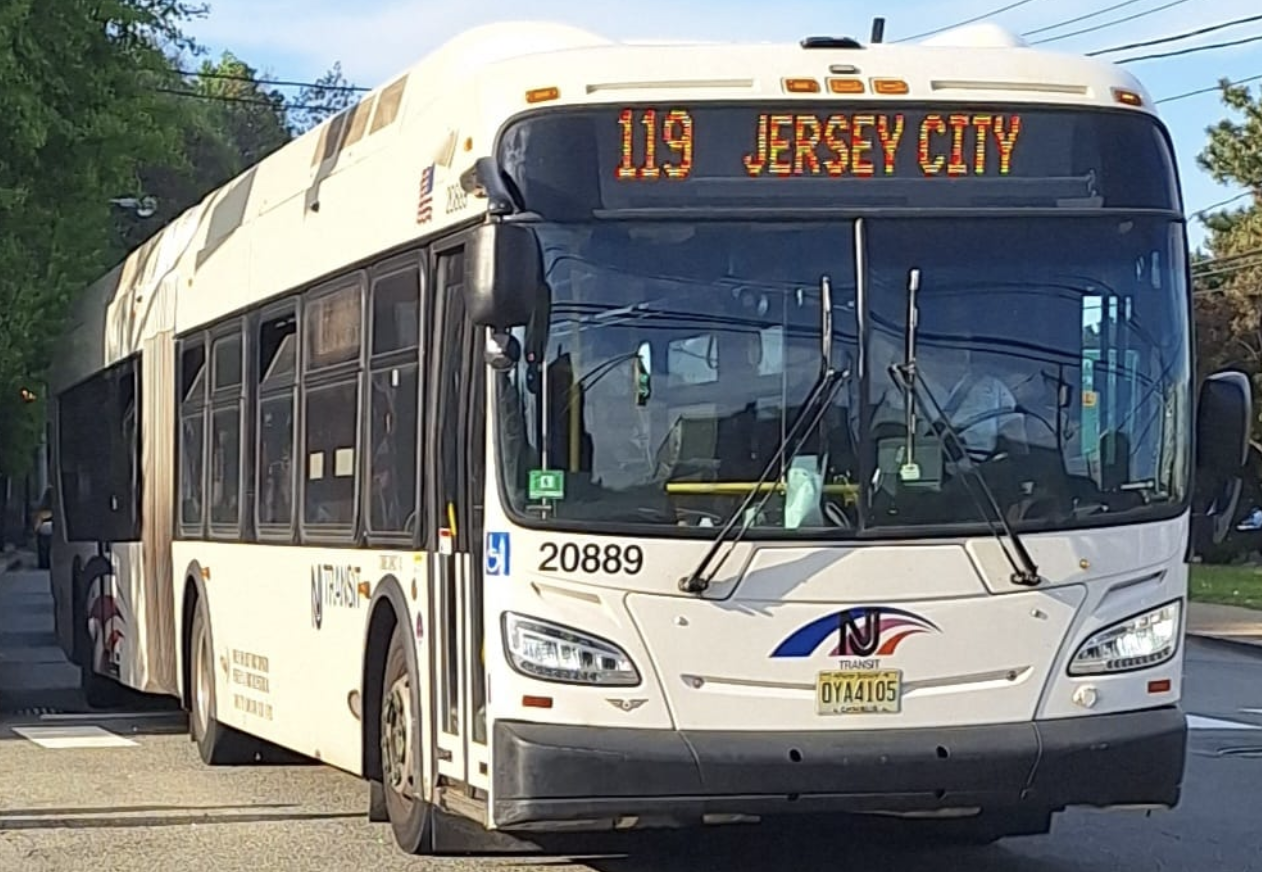
Today is election day in Hudson County. While eight of the nine Hudson County Commissioner seats were ultimately left uncontested after County Executive Craig Guy and Mayor James Solomon’s camps agreed to a “Unity Ticket,” voters and residents deserve better transit options. In this guest post, former Hudson County Complete Streets President Emmanuelle Morgen makes the case for investing in Bus Rapid Transit along JFK in Hudson County. Go vote!
In the rain, in the snow, under the hot summer sun, the 119 is my bus. I know I am not alone. In Hudson County, bus riders log more than 30 million rides per year, nearly half of these are on the 119.


Between the 10, the 88, and the 119, John F. Kennedy Boulevard is one of the busiest NJ Transit corridors in the state. If JFK were a subway line, it would be the fourth most heavily used subway in the United States by annual ridership.
Yet despite millions of passenger trips, it is remarkable how little bus infrastructure we have here in Hudson County. It is not unusual to see 50 people on a bus stuck behind six people in six cars at any given intersection. Or 70 people on an articulated bus stuck behind a double-parked vehicle. While many other U.S. cities enjoy dedicated bus lanes, clean-air buses, and raised and sheltered bus platforms, our cities suffer from painfully outdated infrastructure and fleets, demonstrating just how little Hudson County has valued bus riders historically. Just how little New Jersey has prioritized bus riders historically.

And yet bus passengers reduce greenhouse gas emissions by 47%, significantly reduce roadway congestion, and reduce crashes. In fact, according to statistics collected by the National Safety Council, bus riders are 70 times less likely to result in a fatality than the same trip by car. Bus riders can save thousands of dollars compared to the cost of owning and operating a car.
Fortunately, there is a solution: Bus Rapid Transit. Hundreds of cities all over the world, from New York to Marrakesh to Manila, have implemented Bus Rapid Transit (“BRT”) to get millions of people where they need to go safely, quickly, and efficiently. As defined by the Federal Transit Administration, BRT is a high-quality bus transit system that delivers fast and efficient buses. The FTA also compares BRT systems to LRT, or light rail trains. Imagine a light rail track that runs north-south on JFK, subtract 90% of the cost of light rail, and you can begin to comprehend the potential for BRT on JFK.
Successful BRT systems have a number of key elements:
- Dedicated bus lanes that prioritize bus passengers.
- Elevated platforms that allow passengers to board and disembark quickly and with ease.
- Pre-boarding payment systems, so lines don’t form at boarding.
- All-door boarding, again to speed up service.
Sometimes, BRT systems also have traffic signal prioritization that allows the bus driver to make red lights green.
Jersey City residents have been advocating for BRT on JFK for well over a decade, and fortunately, at long last, along with making Vision Zero a hallmark of his administration, the County Executive has made a commitment to a BRT study in 2026. With the county commissioner elections today, we urge Hudson County’s future and current elected officials to prioritize advancing BRT as this coming term’s signature priority.
Like many West Side residents, I’ve struggled to find street parking. But I know the answer to this problem is not more parking; it’s more frequent transit.
A parking structure in Hudson County costs at least $40,000 per space to build. Per space. When West New York built the 51st Street parking deck in 2023, they did so with $13 million of taxpayer funds, which doesn’t account for the value of the land.
We should know by now that there is no such thing as free parking. Parking not only costs millions in taxpayer funds, it adds more cars, congestion, and dirty air to our streets and cities. Car congestion is dangerous–emergency vehicles can’t get through, residents choke on exhaust from idling engines, and all of us suffer adverse health effects from the noise of horns and sirens meant for highways.
Instead, we can create a fast, dedicated bus route on JFK. Extend the light rail to Bayfront and then to Newark. Provide more crosstown buses and support them with dedicated bus lanes. Remind the Port Authority of their plan for a one-seat PATH ride to Newark Airport.

We can provide better transit options, so West Side and South Side residents can get around without a car, can have more options for transportation. Car ownership is a burden that costs low-income families 30% of their total household budgets. It’s time we reassess what equitable, accessible mobility means, and invest in fast, affordable, and efficient bus transit for all.
Editor’s Note: Emmanuelle Morgen is the long-time leader of Hudson County Complete Streets. She recently stepped down from her position to move closer to family in Europe for a while. The Better Blocks team thanks her deeply for her long-running commitment to safer streets and better transit and for her support of Better Blocks’ own advocacy over the past year. Under Emmanuelle’s leadership, Hudson County Complete Streets has successfully lobbied for Vision Zero in Hudson County, got the Port Authority to increase weekend PATH service, and is now running a Better Bus and Better Light Rail campaign. Check them out below: