

The law allowed Jersey City to block demolition of any building upon recommendation by the Historic Preservation Officer and a vote of the Historic Preservation Commission
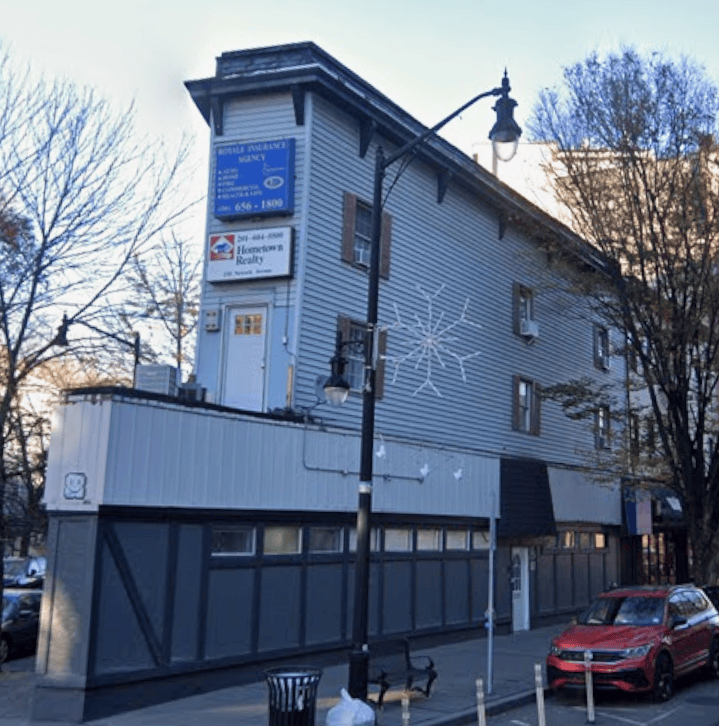

(Above: The city ruled that 250 Newark Ave “retains integrity of design, feeling and association” and “possesses historical significance and integrity that prevents its demolition”)
A demolition ordinance that has created uncertainty and confusion about which properties can be demolished in Jersey City has been nixed by a court. The lawsuit was brought by the owners of 240 and 250 Newark Ave, who had been denied a permit to demolish the structures. On August 26, Judge Anthony d’Elia of the Hudson County Superior Court’s Law Division ruled that Section 105-3 and Section 345-30(E)(1) of Jersey City’s municipal code (popularly known as the “demolition ban”) “violate the [state of New Jersey’s] Municipal Land Use Law and accordingly … are null and void.” [NJ Courts]
Under this law, Jersey City’s Historic Preservation Commission could vote to deny a permit for demolition of any structure in Jersey City, including ones that have not been landmarked and are not in historic districts. It is impossible to know if permission will be granted to demolish any given structure in Jersey City until an application is filed with the city and a report written and filed by the Historic Preservation Officer and then voted upon by the Historic Preservation Commission. No definitive public list of historically significant structures exists, and in fact the Historic Preservation Officer or Historic Preservation Commission can change their mind, determining that a structure can be demolished in one year and ruling that it cannot be demolished the next (rulings expire after one year).
The saga of the demolition ban spans almost a decade, with many twists and turns. Below we go into some background and then detail the current court case.
Background
In 1979, Jersey City’s Municipal Council passed ordinance S-200. Under this ordinance and subsequent amendments, no structure in Jersey City more than 150 years old could be demolished without approval of the Municipal Council. This law provided a clear criterion for which properties could be demolished, since the official age of every building is listed in the property tax assessment records (even if these ages are not always accurate).
Then, in 2016, the council passed an ordinance with two major revisions to this law [MuniCode]. First, the list of protected buildings was expanded to include so-called “Phase 2” buildings. The Phase 2 Historic Resources Inventory is a short list created in 1985 of structures that were likely to be eligible for the National Register of Historic Places [City of Jersey City]. Second, rather than requiring a council vote, demolition could only proceed if the city’s Historic Preservation Officer certified that “the structure no longer maintains its [historic] integrity.” While this expanded the list of buildings prohibited from demolition, the list of Phase 2 buildings is publicly available and limited in scope.
2018 is when the current “demolition ban” system really went into force. In that year, spearheaded by Councilman Michael Yun and championed by then-mayor Steven Fulop, an ordinance was adopted by the council that applied to all demolitions of any building in Jersey City [MuniCode]. All such applications were to be reviewed by the city’s Historic Preservation Officer. Demolition could only proceed if the Historic Preservation Officer certified that “the subject building or structure possesses no cultural, historical or architectural significance which would merit its preservation.”

In 2019, however, Joseph Berardo applied to demolish a house he owned at 32 Sherman Place in the Heights. The house was built in 1908, making it a relatively new house in a city where most single-family houses were built in the 19th Century. It also was stripped of its original front porch, siding, and ornamentation [City of Jersey City]. While acknowledging this, the city’s Historic Preservation Specialist ruled that “the building is an excellent example of a late Victorian Shingle Style residential dwelling and that its demolition would negatively affect the historic, architectural, and cultural character of the Heights and the city of Jersey City.” After appealing the ruling to the city’s Zoning Board and being denied there as well, Berardo sued the city to invalidate the ordinance. In November 2021, he lost his case in the Hudson Superior Court’s Law Division, but in 2023 the Appellate Division ruled that having a Historic Preservation Officer issue determinations about buildings’ historical significance was “inconsistent with objectives and procedures concerning historic preservation mandated by the MLUL [NJ Municipal Land Use Law] to the extent they delegate powers reserved for a municipality’s historic preservation commission to the HPOs [Historic Preservation Officers]” [NJ Courts].
Rather than issue the permit for the demolition of 32 Sherman Place, in 2025 the city amended its demolition ban to try to get around the court ruling. Rather than the Historic Preservation Officer, now the Historic Preservation Commission made the final decision denying any permit [Municode].
The Case That Brought Down The Demolition Ban (Again)
In 2025, the owners of 240 and 250 Newark Ave applied for a demolition permit for their property in downtown Jersey City. The three-story vinyl-siding-clad buildings feature discount steel doors that are commonly sold at Home Depot and a foreboding, nearly windowless ground floor covered in plywood paneling. Despite this, the city’s official report contends that each building “retains integrity of design, feeling and association” and “possesses historical significance and integrity that prevents its demolition.”
Just like Berardo, the owners of 240 and 250 Newark appealed to the Zoning Board, who upheld the Historic Preservation Commission’s ruling. Then, in January 2026, they filed suit in Hudson County Superior Court Law Division [NJ Courts]. This time, however, the Law Division ruled against the city.
The judgment states that “the MLUL limits the jurisdiction of a historic preservation commission to review permits as it relates to those properties which have been designated as historic sites or located within designated historic districts.” In other words, municipalities must specifically call out which properties within their boundaries are historic before the fact, rather than determining which are historic and can’t be demolished after the fact.
The ruling separately states that the decision of the city’s Zoning Officer and of the Zoning Board of Appeals denying the demolition permit was “arbitrary, capricious, and unreasonable and therefore reversed.”
Moreover, since the law gives the Historic Preservation Officer a role in writing a recommendation report for the Historic Preservation Commission, the judge ruled that “the Ordinance is null and void to the extent it excludes the Historic Commission from exercising the jurisdiction and authority conferred” by state law.
Finally, the ruling enjoins (bars) city officials from enforcing the ban as it relates to 240 and 250 Newark.
While the Newark Ave lawsuit was still pending, Berardo was once again denied a demolition permit for 32 Sherman Pl (under the new 2025 law) and once again filed his own lawsuit. While that lawsuit is still pending, it would seem that the ruling in the 240-250 Newark Ave case would permit demolition to proceed on 32 Sherman Pl as well because it declared the demolition ban ordinance null and void.