
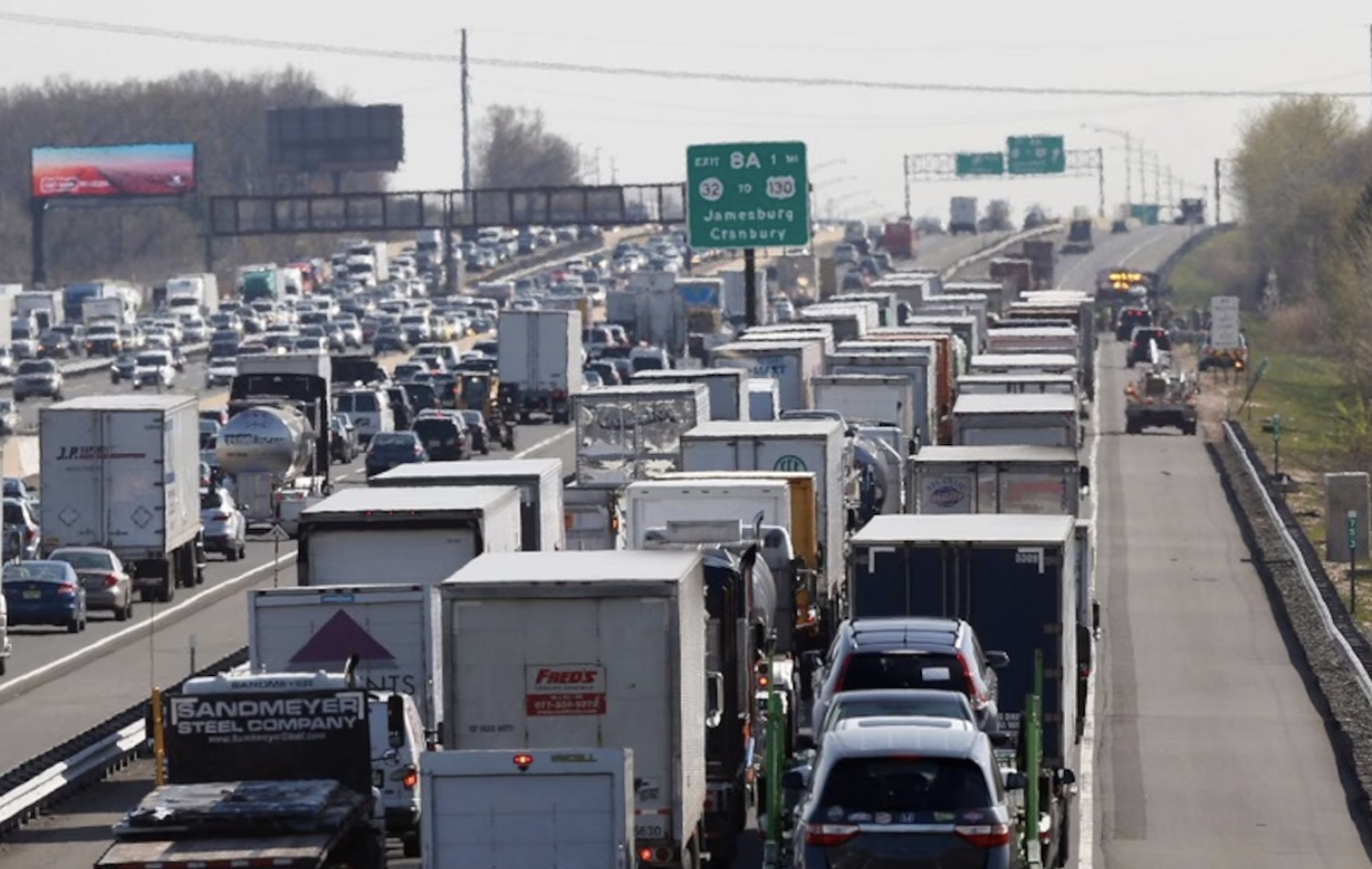
Congestion pricing in New York City has been a success. Traffic is down and over $500 million a year has been raised for transit. Ever since New York announced the toll, New Jersey’s politicians have generally fallen into one of two camps when pressed about the program: swearing complete opposition to the program on one end, or calling for punitive “reverse congestion” pricing on the other.
New Jersey’s leaders have some cause for concern. Despite carrying over 270,000 commuters into Manhattan every day, NJ Transit currently does not receive any slice of the congestion pricing pie. Previously, Governor Hochul is alleged to have offered New Jersey in excess of $100 million in funding for NJ Transit as a settlement [NY1]. Hopefully a similar arrangement is still on the table as both states head to mediation.
Although New Jersey has not received much in the way of financial support from congestion pricing, the state has still benefited from the program. Traffic and air quality in Hudson County have improved and rush-hour commutes for bus riders are faster than ever [Nature]. Putting an end to the program would worsen quality of life for nearly a million New Jerseyans.
But New Jersey cannot easily implement its own “reverse” congestion pricing as revenge either. Boundary-based cordon tolls like congestion pricing require special authorization from the federal government. Cordon tolls require special federal approval under the Value Pricing Pilot Program (“VPPP”), which the Trump administration has repeatedly assailed. Aside from the low likelihood of the Trump administration approving new congestion pricing programs under VPPP, implementation is lengthy and time-consuming even with the support of the federal government. New York’s program took over six years to implement following the legislature’s approval in 2019 (and over a decade of lobbying from Mayor Bloomberg).
New Jersey, fortunately, has an alternative that can ease highway congestion, speed up your commute, and raise lots of new revenue to make NJ Transit more reliable — dynamically priced High Occupancy Toll (or, “HOT”) lanes on the Turnpike, Parkway, I-78, and I-80. In this article, we will explore what HOT lanes are, use Virginia as a precedent for managing congestion and funding transit, and explore how New Jersey can adopt a similar program under the leadership of Governor Mikie Sherrill and Kris Kolluri, who runs both NJ Transit (“NJT”) and the New Jersey Turnpike Authority (“NJTA”).

It’s HOT to Manage Traffic
HOT lanes are a form of managed express lane that expands upon High Occupancy Vehicle (“HOV”) carpool lanes by allowing riders to pay a toll to access the express lane on a highway. Unlike congestion pricing that requires VPPP approval, HOT lanes on interstates that receive federal highway funds are authorized under 23 U.S.C. §129 or 23 U.S.C. §166 depending on if the implementation is as an HOV conversion or not.
Over eleven states already use managed express lanes and dynamic tolling to control congestion on their highways but the best example for New Jersey to follow is Virginia.
Opponents of tolling deride HOT lanes as “Lexus Lanes,” criticizing them as a means for the rich to avoid traffic and forcing poorer drivers into clogged roads. Research shows that more than 60% of road users from across economic backgrounds support HOT lanes because trip reliability increases and congestion improves after dynamic tolling is implemented in managed lanes [U.S. DOT]. On interstates like I-78 and I-80, no one would be forced to pay the toll as general purpose lanes would remain, but the express lanes would be converted to managed lanes with dynamic tolling, helping to speed up through traffic. For the Turnpike and Parkway, which already have tolls, the standard flat-fee toll would apply to the general-purpose lanes with the inner carriageways converted to express lanes using a demand-based toll instead. Access to HOT lanes would be available to vehicles with three or more riders (for free) and for single-occupancy vehicles (for a fee). The program provides reliability while incentivizing HOV travel choices. And the added benefit is revenue raised from the dynamic tolls would subsidize better bus and rail service for commuters, which provides more reliable alternatives to driving.
Virginia is for (HOT) lovers
Virginia operates I-66’s express lanes with dynamic tolling as part of a network of connected express lanes just outside of the nation’s capital [VDOT]. The dynamic pricing model that Virginia uses allows tolls to respond to real-time demand from cars on the road every six minutes. During off-peak, low-traffic hours tolls can be as low as $2.00, while they can go above $30.00 in heavy congestion. Cars with three or more passengers can use the express lanes for free as regular “HOV” lanes but non-HOV vehicles can opt to pay the toll and enter the express lanes [VDOT].

The results of the program have been lucrative for transit funding and a boon for commuters. The state collected close to $40 million in tolls in 2024 from its dynamically priced express lane corridors on I-66 [DC News Now]. The Northern Virginia Commuter Choice (“NVTC”) program and the Virginia Passenger Rail Authority each received around $11 million from the tolls collected on I-66’s managed express lanes in 2024. Since the state implemented the Commuter Choice program in 2017, money collected from dynamic tolling has allowed Virginia to invest over $150 million in local government and transit agencies to fund bus routes, rail station improvements, and bikeshare programs [NVTC]. Mode shift has also increased with carpooling and bus use increasing 105% across Virginia’s Express Lane system.
Under 23 U.S.C. §166, Virginia was allowed to convert existing HOV lanes to dynamic demand-based HOT lanes. The state then authorized transfers of toll revenue from VDOT-operated I-66 to the NVTC under a 40-year memorandum of agreement. The agreement allows NVTC to fund multimodal transit projects under the Commuter Choice program [NVTC].
New Jersey Needs Congestion Relief and More Transit Funding

New Jersey is even better situated than Virginia to implement demand-based tolling to fund its public transit system. New Jersey has the most extensive network of express-local highway and dual-dual carriageway infrastructure of any state in the country, yet it is not using that infrastructure for dynamic demand-based tolling.
There are four highways in New Jersey that are already configured as barrier-separated lanes that could easily be converted to support dynamic tolling (with new gantries for toll collection and congestion monitoring) at a relatively low cost. The most obvious candidates for conversion are
1) the inner (car-only) lanes on the Turnpike between Exits 6 and 14;
2) the express lanes on the Parkway between the Raritan and Asbury Toll Plazas;
3) the express lanes on I-78 from Route 24 through to the Turnpike toll gate; and
4) I-80’s express configuration between the Parkway and Turnpike.

Although not a physically separated carriageway, the Garden State Parkway between the Driscoll Bridge and I-78 as well as between I-78 and I-280 is wide enough to designate one or two lanes as HOT lanes to alleviate general congestion. Another potential candidate for dynamic tolling is the entire Turnpike Extension, which has been subject to threatened widenings as means to “alleviate” congestion; demand-based tolls would be much more effective at regulating demand to use that portion of the highway, especially during peak travel periods.
New Jersey briefly experimented with HOV managed express lanes on I-80 and I-287 in the 1990s but discontinued the program due to low volume, poor enforcement, and popular backlash in the press [HOV Lane Case Study]. The Turnpike still uses HOV lanes between Exits 11-14 but does not charge extra for their use. Interestingly, the Turnpike has experimented with peak and off-peak pricing, but it is static time-based tolling rather than demand-based dynamic tolling with a small 15% premium applied to all Turnpike users during peak hours.
HOT lanes are more effective than traditional HOV because HOT lanes give solo drivers the option to pay to use the express lane, which is an opportunity for the state to use the revenue raised to fund transit improvements, further helping to alleviate congestion. HOT lanes are also more effective than static time-of-day pricing in regulating congestion because the price of the toll responds to real-time highway usage.
New Jersey is also in a strong position to implement HOT lanes because there is already precedent for using toll revenue to fund transit in New Jersey. The New Jersey Turnpike Authority, which oversees the Turnpike and Garden State Parkway, transfers $500 million a year to NJ Transit from standard toll revenues.
We used Virginia’s data and NJDOT traffic count data (2012-2022) data to model the annual average daily traffic (“AADT”) and peak travel share for I-78 and I-80 of the proposed managed lane corridors to estimate HOT lane usage in New Jersey, which we have modeled as an interactive widget that you can explore above. Turnpike and Parkway AADT is harder to estimate as the most current traffic data is not readily available. Based on the above assumptions, we conservatively estimate that implementing demand-based dynamic tolling on express lanes on the Turnpike, Parkway, I-78, and I-80, it is possible to raise an additional $110-116 million a year in dedicated funding for NJ Transit, which should go to bonding much-needed capital improvements.
Readers are free to update our model inputs and assumptions to see how much revenue can be generated from the various corridors. And if any reader has more recent Turnpike and Parkway data, please share it with us and we can update the general model to provide more accurate traffic and toll-collection estimates.
Why HOT Is Good
Like congestion pricing, dynamic demand-based tolling is a proven and effective way to reduce congestion and raise revenue for mass transit projects. The NJTA is well versed in estimating demand elasticity in response to toll increases so, as an agency, it knows that pricing is an effective way to manage congestion. The benefit to dynamic demand-based tolling, however, is that the new HOT lanes will self-regulate with a price being set based on real-time demand from drivers, allowing the lanes to remain both free from congestion and raise the optimal amount of revenue for transit funding.
The Road to Implementation
Implementing HOT lanes on New Jersey’s highways requires navigating two separate legal tracks: One for the NJTA-operated Turnpike and Parkway and another for the federally funded I-78 and I-80. The good news is that making HOT lanes a reality is a shorter legal road than you might think for some segments (albeit politically bumpy).

For the Turnpike and Parkway, the New Jersey Turnpike Authority has the statutory authority to adjust toll structures, but it takes a Board resolution and the Governor’s sign-off [NJ Rev Stat § 27:23]. Converting the existing HOV lanes to HOT lanes would require a standard administrative rulemaking process, typically completed within 60 to 90 days. The trickier question is making sure the new revenue flows to NJ Transit rather than disappearing into the NJTA’s general fund. Currently NJTA toll revenues support NJ Transit on a short-term basis through annual appropriations, subject to debt obligations and federal Title 23 rules. Ideally, a long-term memorandum of agreement between the two agencies, modeled on Virginia’s 40-year agreement with the NVTC, would lock in the funding relationship.
For I-78 and I-80, the Legislature would need to pass legislation enabling NJDOT to designate and manage express lanes under the authority provided by Title 23. Virginia enacted equivalent authority broadly, covering all eligible highways in one bill rather than authorizing individual projects one road at a time. New Jersey should do the same.
The federal path forward has two steps, but both are well-established. First, NJDOT would designate the existing express lanes on I-78 and I-80 as High Occupancy Vehicle facilities under 23 U.S.C. § 166, restricting them to carpools and buses during peak hours. Once those lanes demonstrate that they are operating above the federal performance threshold — vehicles maintaining a minimum average speed of 45 miles per hour at least 90 percent of the time during peak hours over a 180-day window — NJDOT can convert them to HOT lanes, allowing solo drivers to pay a dynamic toll for access [Guidance on HOV Lanes]. That two-step sequence is the same path Virginia used on I-66, and it is far more straightforward than New York’s decade-long road to congestion pricing: there is no federal pilot program application, no act of Congress, and no FHWA approval required. It also avoids restrictions on immediately tolling general-use highway lanes. What’s needed instead is endorsement by the North Jersey Transportation Planning Authority along with an environmental review and ongoing annual performance certifications to FHWA.
Once the state enabling bill passes, a memorandum of agreement (same as with the Turnpike and Parkway) would govern how I-78 and I-80 revenues flow to NJ Transit. Once authorized, New Jersey would need to invest in gantries and technology to monitor traffic demand and collect toll revenue from E-ZPass transponders and toll-by-mail, which is the same infrastructure that Virginia, Maryland, and a dozen other states have already deployed in support of their programs.
The biggest obstacle to making New Jersey a HOT lane state is not the legality of the program but the political challenges. Politicians, always sensitive to criticism and pushback, will fear any potential blowback from 101.5, which will lambast the planned “Lexus Lanes” as a backdoor toll hike.
It is critical that advocates stay focused on advancing this plan as a way to help clear congestion, finally fix NJ Transit’s lack of dedicated funding, and, if necessary, paint it as revenge on New York drivers for implementing congestion pricing.