
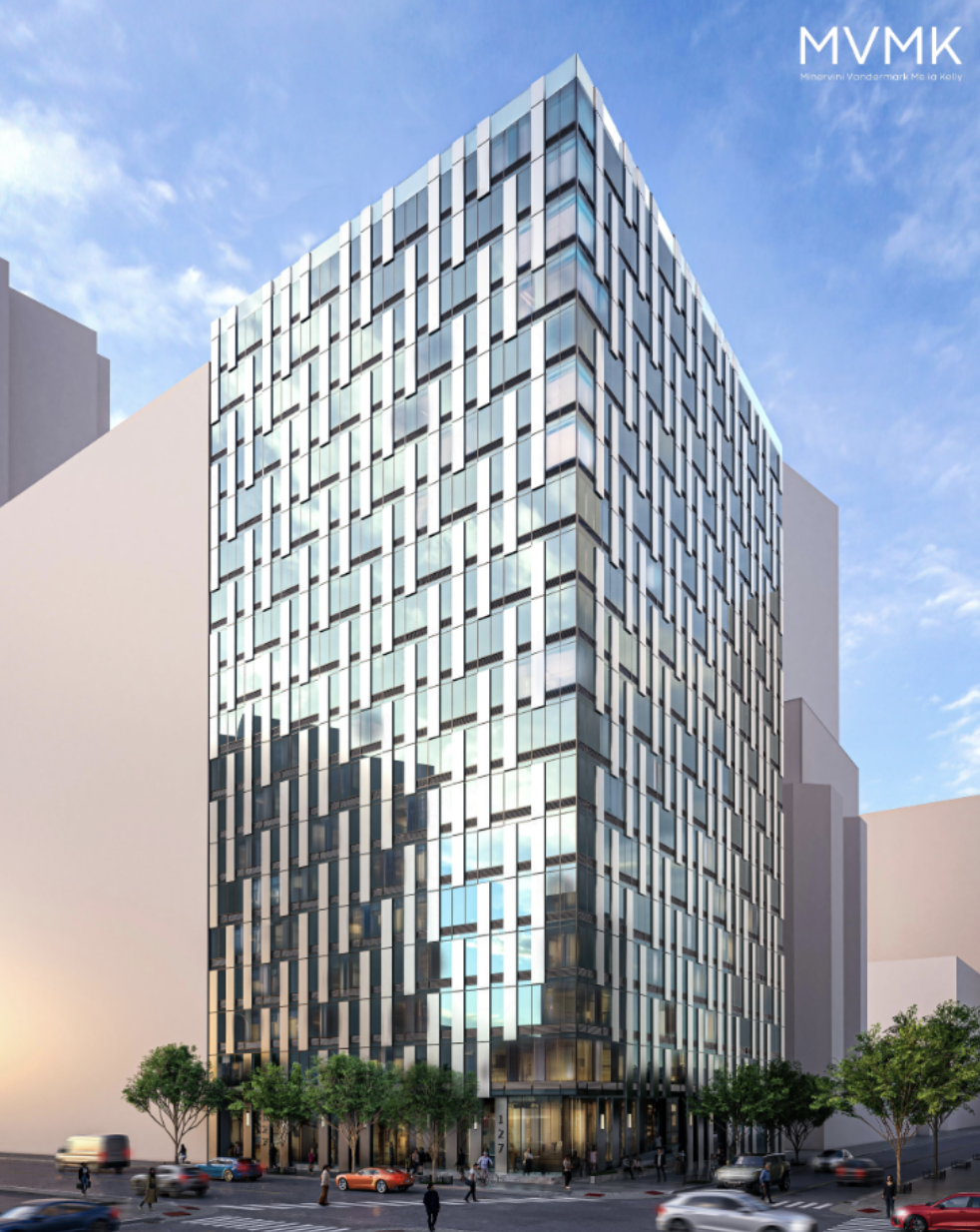
A parking lot that collects only $6,700 a year in city taxes sits blocks from PATH and light rail. A 20-story building on the same parcel would generate over $1.25 million for the public school system, $1 million for the city, and nearly $500,000 for the county in property taxes. The council is being asked to decide which option is better for Jersey City.
In late June, residents packed a community meeting to discuss a proposed development at 127 Morgan Street, a planned 20-story, 240-unit mixed-use building in the Powerhouse Arts District. The meeting covered a diverse range of topics including dance, garbage, traffic safety, and schools. Unfortunately, it did not spend much time on the question that hangs over all of it: Jersey City is in the middle of a fiscal crisis, it has a parking lot generating almost no tax revenue sitting blocks from three transit options, and the council is being asked whether to let something get built there… or not.
What’s Proposed
The project has already been cut significantly. The developer originally wanted to build 35 stories on that lot. What they presented at the community meeting was just over half their original proposal — down to just 20 floors with 240 units (24 studios, 126 one-bedrooms, 74 two-bedrooms, 16 three-bedrooms), 15% income-restricted “housing lottery” units, a community arts space, and a set of street safety improvements: realigned crosswalks, extended curb cuts, and converting the Morgan/Washington/Warren block to one-way with the possibility of bike lanes and a raised intersection. There will also be new street trees, increasingly relevant as just a few days after the meeting Jersey City baked under one of the worst heat waves in recent memory.
To build it, the developer needs an amendment to the Powerhouse Arts District Redevelopment Plan: raising the height limit from 90 to 210 feet, allowing higher density, and removing the off-street parking minimum. As such, its fate — much like 150 Bay Street — is tied to the whims of the Jersey City Council and the city’s unworkable 15% IZO for downtown.
The Math on Taxes is Clear
The lot as it exists today is a 40-space valet parking operation that paid a paltry $19,102 in property taxes last year. Of that, only $6,700 reached the city with the rest going to the county and schools. For comparison, the nearby Lively — 175 units — pays roughly $2.1 million annually in property taxes, or about $12,000 per unit. At that rate, 127 Morgan’s 240 units would generate approximately $2.8 million a year if it were built without a PILOT agreement. Broken down: about $1 million to the city, $1.25 million to the Board of Education, and the remainder to Hudson County and other funds.

That’s 140 times what the parking lot currently pays the city.
For context: the administration’s proposed 15.5% property tax hike is designed to close a roughly $90 million structural deficit. The $1 million in annual city revenue from 127 Morgan as proposed represents about a quarter of a percentage point of that hike. While not a silver bullet, it is significantly more recurring tax revenue than the city receives today.
And 20 stories is not the ceiling of that lot’s potential. The original 35-story proposal, using the same per-unit rate, would have penciled out to roughly $4.9 million a year in total property taxes. Anti-housing activists cut $2 million a year in future tax revenue when they balked at a 35-story high-rise downtown and forced the developer to present the paired down 20 stories.

The only real financial risk is the mandatory 15% affordable housing set aside that Mayor James Solomon pushed on downtown when he was councilman. This means the project might need a PILOT to break ground, similar to 177 Grand Street, which would increase the share of revenue flowing to the city but shift the burden of increased school costs to other taxpayers.
The Neighborhood Character Argument Doesn’t Hold Here
One of the most common objections to taller buildings is neighborhood character — the idea that a 35-story tower would be alien to its surroundings. A short walk from 127 Morgan sits 160 Morgan: a 38-story, 417-unit tower with ground-floor commercial space. Its property tax bill runs between $3.9 and $4.4 million annually.
Despite activists’ complaints about height and density, the taller building at 160 Morgan already exists as a functioning part of this neighborhood, and the neighborhood has not collapsed around it. And right across the street, a new 34-story tower is currently under construction at 107 Morgan.

If 160 Morgan can go to 38 stories and 107 Morgan across the street can reach 34 stories, then the argument that 127 Morgan must stop at 20 is hard to make on the “neighborhood character” grounds routinely advanced by groups like PADNA, the local neighborhood association. As currently zoned (without any amendment) the parcel supports roughly 12 stories. Using the same per-unit math, that’s approximately $1.4 million a year in property taxes, versus $2.8 million at 20 stories and $4.9 million at 35.
Nobody would propose tearing down an existing 35-story downtown building to replace it with a 12-story one, trading away hundreds of units and millions in annual revenue. The question is why 127 Morgan is being asked to make that same trade by the local neighborhood association just because it hasn’t been built yet.
The Downtown School Problem Is Real
The most substantive objection at Thursday’s meeting came from PS16 parents, who have shown up to multiple council meetings demanding that the city address school overcrowding before approving new development downtown. One parent — an architect — brought detailed plans showing how the parcel could incorporate both a school and residential units.

This is a legitimate concern, and proposals have been put forward to build a new school building downtown. Councilperson Little confirmed that the Planning department has five sites under consideration for a potential new school, but 127 Morgan is not one of them. The developer offered a more direct answer: they could potentially incorporate a school and the arts space and the affordable units, but only if the building goes to roughly 60 stories. That’s the economic reality of requiring a developer to absorb the cost of a public school: you either pay for it in height or you don’t build it.
Some PS16 parents proposed delaying all development until the school question is resolved. It’s an understandable impulse but ultimately counterproductive. Councilperson Little noted the state would likely step in given the city’s deficit. But there’s a more direct problem with that position: our school and our city costs money (a lot of money) to run. And delaying development that would fund it doesn’t make money magically appear; on the contrary, it would make the city’s fiscal problems even worse. A 12-story 127 Morgan generates $1.4 million a year. A 20-story 127 Morgan generates $2.8 million. That gap — sustained over years — is what funds more and better public services, including the public schools.
The failed 2022 Laurel Saddlewood project offers a cautionary parallel. That proposal, on a larger parcel with a planned school component and roughly 50 stories, was pulled after increased costs and last-minute political demands on affordable housing and labor requirements from the Fulop administration made it financially infeasible. The school didn’t get built and downtown has suffered for it every since.
Death by a Thousand Meetings
Thursday’s meeting also featured several minutes on elevator configuration, building materials, and garbage placement — before project opponents arrived at a conclusion that the project was simply too dense for downtown. This is a recognizable pattern: no single objection is ever decisive, but the cumulative weight of them wears a project down, meeting by meeting, until it’s either abandoned or so reduced that it barely pencils out.
That same approach helped Solomon, when he was still on the council, sink the resolution to study a new tower at nearby 150 Bay Street late last year — a project that, as a developer giveback, would have included space for a new public school. Given the priorities of the current administration and council, that project and school likely won’t come to fruition either.
Who Subsidizes Whom?

At recent city council meetings and caucuses, several council members have proposed higher tax rates on large apartment buildings, on the faulty premise that renters and their landlords aren’t paying their fair share. DSA Councilmembers Joel Brooks and Jake Ephros argued for taxing luxury apartments at higher rates. Councilman Frank Gilmore floated a municipal income tax to make people who work on the waterfront “chip in.”
Both proposals share an assumption: that the people who would live in a building like 127 Morgan are outside the tax system or short-changing it in some way. That’s a ridiculous premise for elected officials to hold and is easily refuted by the data.
Landlords factor property taxes into rent. Property taxes influence when (or if) a project ever gets built. A portion of any tax increase passes through to tenants over time — economists debate exactly how much and how quickly, but not on the direction of the relationship. The 240 households that would move into the 127 Morgan area would be part of this system. They’re also, in the aggregate, exactly the kind of residents — transit riders, local consumers, and city-dwellers — that downtown’s businesses and infrastructure are well-suited to serve.
A 20-story building on a transit-rich block in downtown Jersey City doesn’t burden the rest of the city; it subsidizes it. And cutting a building down even more to 12 stories doesn’t protect anyone or enhance neighborhood character, but it does decrease the tax or PILOT revenue the city could collect.
These demands by local neighborhood organizations to veto changes over property they do not own are a tax on the city’s growth and they result in higher costs for existing taxpayers and renters. The city’s entire taxbase is being asked to subsidize the aesthetic preferences of a handful of residents who live in high-rise apartments and condominiums but are opposed to new high-rise apartments downtown. One reason why your recent tax bill is higher is, at least in part, we still have a parking lot on Morgan Street that pays less than $20,000 a year in property taxes and there are plenty of activists who want to ensure nothing ever gets built there.
One response to “Downtown Development Can Pay for Everything: The Case for Building 127 Morgan Right”
LOL. Concerns were from: 1) people who already own condos in their Toll Brothers Luxury condominiums next door. Oh brother; and 2) renters who will be pregnant within a year and on their way to a house in Maplewood because “Jersey City is no place to raise a kid”. Wreaking shameless havoc for everyone else but themselves.