
Mayor Solomon and his administration have repeatedly told Jersey City residents that it is a time of austerity, and there is no money to spare. As such, they raised the municipal portion of the tax levy by 15%, while cutting back on Via service, and reduced funding for public parks and public works. As mayor, Solomon has repeatedly emphasized the need for hard choices. He castigated his predecessor for using one-shot revenues to cover budget deficits and prioritizing short-term political gain over the city’s long-term fiscal health [Jersey City]. Land sales, in particular, have drawn Solomon’s ire as a “cause” of the deficit [Hudson County View].
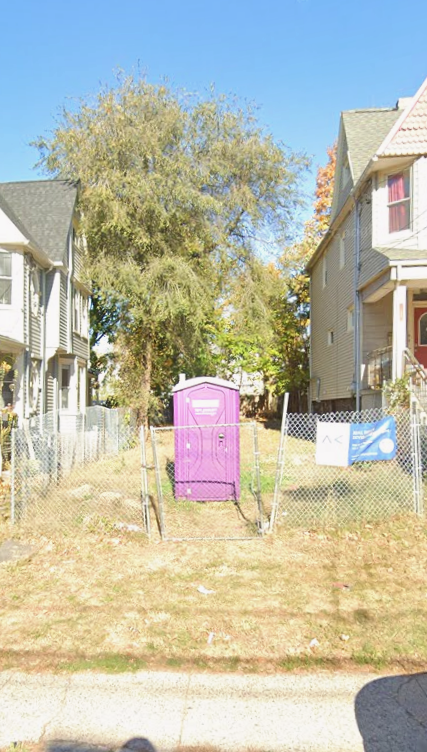
Yet this Thursday, despite the city’s supposed budget woes, the city council will vote for a first reading on purchasing 128 Glenwood for $1.2 million for the purpose of creating a community garden. The developer bought the land in 2022 for $425,000, and was planning to build a small apartment building consisting of three and four bedroom apartments — a housing type that Councilman Zuppa has called “badly needed.” To fund the city’s land purchase of the currently vacant lot, $230,000 will come from the city’s liquid fund and the remaining million comes from Community Development Block Grant (CDBG).
City purchases of land, much like the sale of city-owned land, are not necessarily bad one way or the other. Jersey City purchased 95 acres from Honeywell for $90 million in 2018 to build a new mixed-use, mixed-income community at Bayfront that will house thousands of new families.
Public Park or Secret Garden?
Here, however, the Solomon administration’s plan for 128 Glenwood is much less ambitious and less beneficial to the public overall. After the purchase, the administration will place the lot into Jersey City’s Adopt-A-Lot program and issue an RFP for a nonprofit operator — most likely selecting the McGinley Square Community Board, which has pushed for the acquisition for three years, and deserves as much credit for its persistence as opprobrium for its opposition to in-fill housing.
Under the Adopt-A-Lot program, the city retains title and leases the lot to a nonprofit for $1 per year on a one-year renewable term. The operator handles maintenance, programming and fundraising. In exchange, the garden must keep its gates open a minimum of twenty hours per week, from May 1 through November 30.
That floor is roughly 610 hours a year. Out of 8,760, which is a mere 7% of the calendar. By comparison, the city’s traditional public parks are usually open 16 hours a day, 365 days a year and remain unlocked even “after hours.” And a multi-family apartment building would have provided homes to four families year round, day in and day out.
The city’s own listings show operators hitting close to that floor and no higher. The Brunswick Community Garden downtown posts Saturday and Sunday, 8 a.m. to 6 p.m. — exactly twenty hours. Riverview posts ten. Mandela Lot posts nine, on weekday mornings. Outside those windows, the gates are locked, and access to the interior is generally limited to members.

This is not a knock on community gardens and the volunteers who maintain them. Twenty hours is what the lease requires, volunteers are volunteers, and locking the gate outside of operating hours keeps all the hard-worked vegetable plots safe.
But Jersey City should not spend $1.2 million on land for community gardens that are off-limits to the public 93% of the year at the same time that the budget for public park maintenance has been significantly cut. This project also flies in the face of a previous Solomon administration promise to turn “vacant lots” into affordable housing. Here, a developer owns a vacant lot and wants to build housing on it but the administration is working to prevent housing from being built.
Community Development Block Grants and the Budget
Some council members, like Joel Brooks who defended the proposed purchase in an email, have noted that only $230,000 comes from city funds; the remaining funds will come from Community Development Block Grant (“CDBG”) money.
CDBG dollars are restricted. The city cannot legally redirect them to DPW salaries, to Via, or to plugging the operating deficit. Anyone arguing “spend it on trash pickup instead” is arguing for something that isn’t allowed.
But the constraint cuts the other way too. CDBG is a fixed annual entitlement. Every dollar of it spent on this acquisition is a dollar not spent on something else that is CDBG-eligible — and the list of eligible uses is not short. Public facility improvements are eligible. Housing rehabilitation is eligible. Public services for low- and moderate-income residents are eligible.
Which brings us to Five Corners, which is a branch of the Jersey City Free Public Library. The branch closed because its HVAC system — original to the building’s 1957 construction — failed. Replacing it requires asbestos abatement first [Jersey City Times]. But the CDBG funds that the administration proposes to spend on 128 Glenwould could, instead, be applied to rehabilitation work at the library, which could run into the millions of dollars. Diverting CDBG funds from other projects to support a community garden comes at a very real cost to the broader community as there are dozens of competing projects that offer higher value to the public.
The Recurring Cost
Beyond the upfront purchase and opportunity cost of using CDBG funds, the city incurs a recurring cost to purchasing 128 Glenwood Avenue.
At the 2025 general rate of 2.335 percent, 128 Glenwood generates roughly $17,700 a year in property taxes across the municipal, county and school levies — as a vacant lot based on the current property tax assessment. Municipal acquisition removes that permanently.

The larger loss is the building that was going to be there. The owner holds a zoning approval (Case Z22-089, a use variance and minor site plan) for a multifamily building on the site — the three- and four-bedroom family units the council has repeatedly said the city needs, in a walkable neighborhood, three blocks from Journal Square’s PATH station and bus terminal.
An illustration, using the developer’s own economics: land in Jersey City infill typically runs 15 to 20 percent of finished value, which puts a completed building here somewhere in the $2.5 to $4 million range. At the current general rate, that is $58,000 to $93,000 a year in property taxes. Over thirty years, undiscounted, $1.7 to $2.8 million — more than the purchase price, on top of the purchase price the city is now paying instead.
So the full transaction is: spend $1.2 million, forgo $17,700 a year immediately, forgo somewhere north of $58,000 a year permanently, and lose the family-sized housing to acquire a space about the size of a tennis court and make it available to the public for only 7% of the year.
Conclusion
In the weeks leading up to the tax hikes, city officials asked their constituencies for patience and promised that they had gone over the budget line-by-line to find every possible savings they could. It is therefore remarkable that, in the council session after which they passed the tax hike, they are buying and giving away a piece of land for a community garden that offers very little benefit to the broader public considering 128 Glenwood is within walking distance of Lapointe Park, Boyd-McGuinness Park, and Lincoln Park already. The public benefits are dubious, yet Mayor Solomon thinks it’s worth $1.2 million even during what he calls the “worst fiscal crisis in the City’s history.”

Were the neighbors on Glenwood Avenue to purchase, cultivate, and pay property taxes on this lot, then that would be their right, and we would whole-heartedly support them in their endeavors. Since they are not using private funds, however, Jersey City taxpayers should not be subsidizing a local community’s hobby.
We are not against the city buying or selling land. Cities should invest through downturns and evaluate land based on costs and benefits to the public and the city’s bottom line. Is this land worth $1.2 million now and millions more in forgone tax revenue? The answer is a resounding no. Therefore, the council must vote this proposal down.