
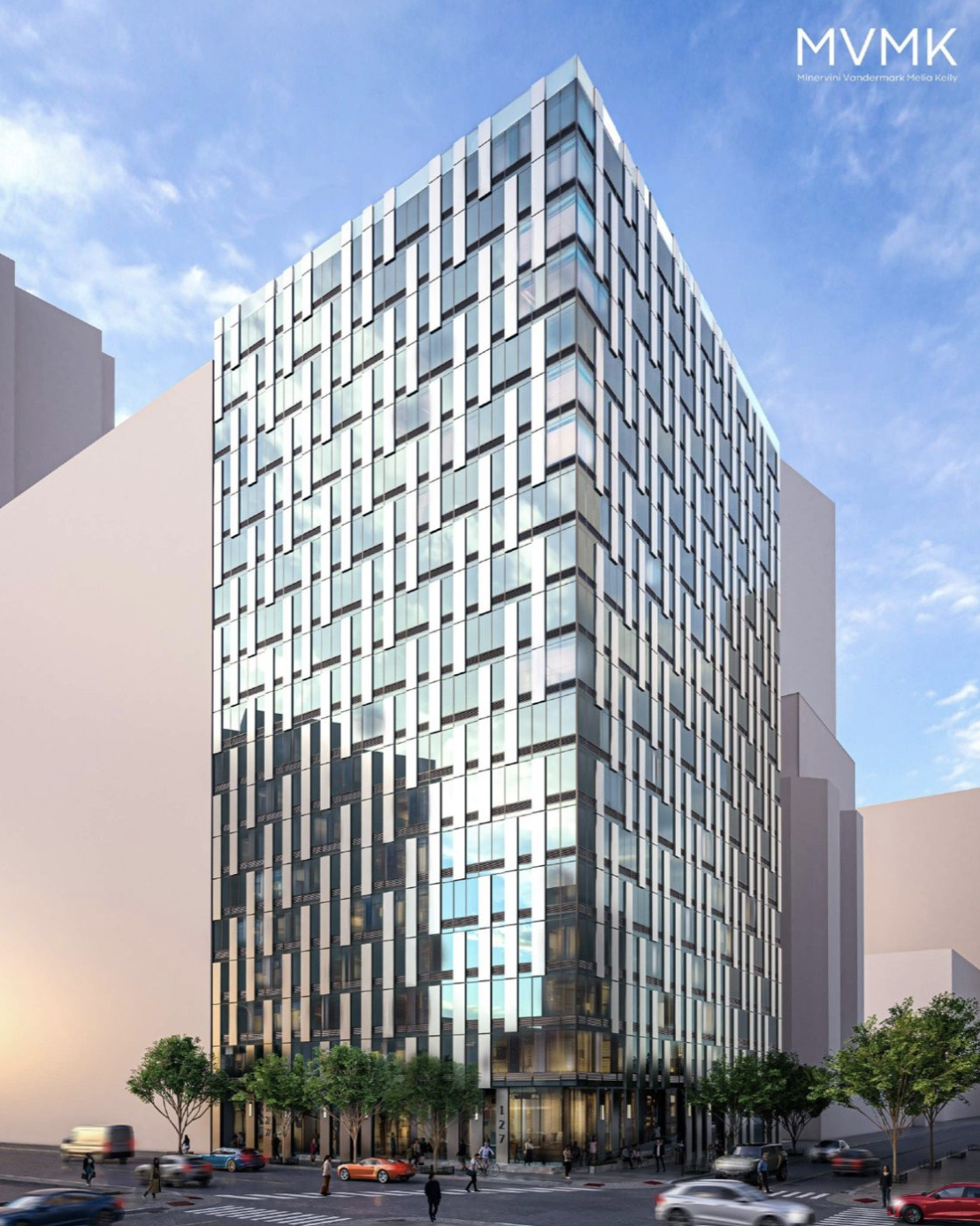
The proposed rezoning for 127 Morgan Street has yo-yo’d on and off the council’s agenda for the past few months over the issue of affordable housing, height, and community givebacks. We use this delay to continue our look at the proposed 127 Morgan Street rezoning following our previous article on the project [Better Blocks NJ].
127 Morgan Street is a site in the Powerhouse district of downtown Jersey City that first sought a rezoning for a mixed-income, mixed-use building over a year ago. The council introduced a rezoning ordinance in September and then pulled it. The version now back on the agenda for its second reading on November 12, Ordinance 26-087, introduced a couple of notable changes.The developer now has two options (in addition to just using the existing zoning): up to 21 stories with 15% of the units affordable, or up to 28 stories with 20% affordable. It also adds a five-foot step-back along Morgan Street above the ninth floor at the request of PADNA, the local neighborhood association.
To date, no downtown project with a 15% or 20% set-aside has gone forward without a payment-in-lieu-of-taxes (“PILOT”) agreement with the city. Raising the requirement without adding height and bridging the financial gap would be the surest way to keep the lot a parking lot. Even when a project does get built, the affordable units aren’t free as developers maximize profits by passing on costs. Someone pays for them: market-rate tenants, through higher rents, or the city and county’s taxpayers, through PILOT agreements and reduced land values.
Given that the 15% version may well have an infeasibly high affordable housing set-aside, readers may wonder what the logic might be of presenting a version with an even higher set-aside at 20%. In interviews, Mayor Solomon has indicated he will only give PILOT agreements to buildings that provide 20% of their apartments as below-market-rate rentals or provide substantial expensive givebacks like schools [James Solomon Policy Paper]. State subsidy programs such as Aspire tax credits also require 20% of units be set aside as income-restricted apartments for very-low- to moderate-income households.
It’s entirely possible that 127 Morgan, if approved as proposed, still wouldn’t break ground for years because the capital markets won’t finance it at these mandate levels unless market-rate rents climb high enough to close the gap. Jersey City has seen several approved mixed-income projects downtown stall out and remain unbuilt years later despite massive up-zonings, most notably 72 Montgomery Street, a proposed 56-story building with 600 apartments (90 below-market-rate). These delays due to unfunded affordable housing mandates mean housing becomes scarcer and the city collects less tax revenue from new developments. And affordable housing set asides have trade offs that slow housing production or raise housing costs.


The much larger building for 72 Montgomery Street (proposal pictured above) has yet to break ground since it was announced.
At a 15% set-aside, the 240-unit building has 36 affordable units. The 20% option raises the allowed floor-area ratio from 15 to 21. Built out with the same unit sizes, that building would hold roughly 336 homes, about 67 of them affordable. That’s 31 more units for the housing lottery that are theoretically subsidized by about 65 more market-rate ones: roughly two market-rate apartments for every additional below-market-rate apartment. Without the extra height, a 20% requirement on the 240-unit building would simply make the project even harder to finance due to the high costs of providing mandatory below-market-rate affordable housing units.
Jersey City’s inclusionary zoning ordinance has a dubious record downtown: no project at 15% has broken ground without a PILOT. The only downtown project that has moved forward with a 15% set-aside (177 Grand) required a PILOT agreement

The Choice Before the City Council
When the council takes 127 Morgan back up at the next session, our elected officials are taking a small step in determining how much of the city’s housing supply to reserve for the housing lottery, who pays for it, and if a “bonus” is enough to get more affordable housing built.
At 21 stories with 240 units, the math is what it is: 36 lottery-affordable units, cross-subsidized by 204 market-rate tenants, generating roughly $2.8 million annually in property taxes. At 28 stories, a building of roughly 336 units would carry about 67 affordable units and, at the same per-unit rate, generate about $3.9 million a year. At 12 stories — the as-of-right baseline — the project generates roughly $1.4 million a year but far fewer homes get built. Worst case scenario is the lot remains surface parking because the added floors are not enough to subsidize the added below-market-rate units from the increased affordable housing set aside. Another possible outcome is that the city enters into a new PILOT agreement or seeks Aspire tax credits to pay for the required affordable housing.
This vote is important for two reasons: 1) it recognizes that affordable housing costs money to build and operate and tries to compensate for it with additional floors and apartments; and 2) it shows that PADNA, the local neighborhood association, will allegedly support up-zoning and additional density downtown so long as a five foot setback is granted at the 9th floor. Our main concern at this stage is that the added density is not enough to compensate for the increased affordable housing, including in a project nearly twice the unit count of this proposal. No apartment building has broken ground downtown with a 15% set aside of below-market-rate apartments (nevermind 20%) without a PILOT agreement.
Increasing the unit count and number of floors will increase the total number of income-restricted affordable housing units produced so the council should focus on the count of units rather than the percentage. If the amended 127 Morgan Street plan still cannot break ground without a PILOT, then the council can always revisit and lower the required set aside to 10% (or, ideally, both), which is a formula that has successfully produced affordable housing in Journal Square without PILOT agreements. In the meantime, we urge the council to vote yes on this amendment to the redevelopment plan and approve the zoning changes needed for 127 Morgan Street.
4 responses to “Will 127 Morgan Need a PILOT to Go Higher and Go for Aspire?”
What is the existing zoning height limit and why not just go with that?
As currently zoned (without any amendment) the parcel supports roughly 12 stories and has mandated parking.
Aspire applications are paused as of July. A redevelopment of the Voorhees mall just failed because of it.
Yeah, it’s a big problem.