
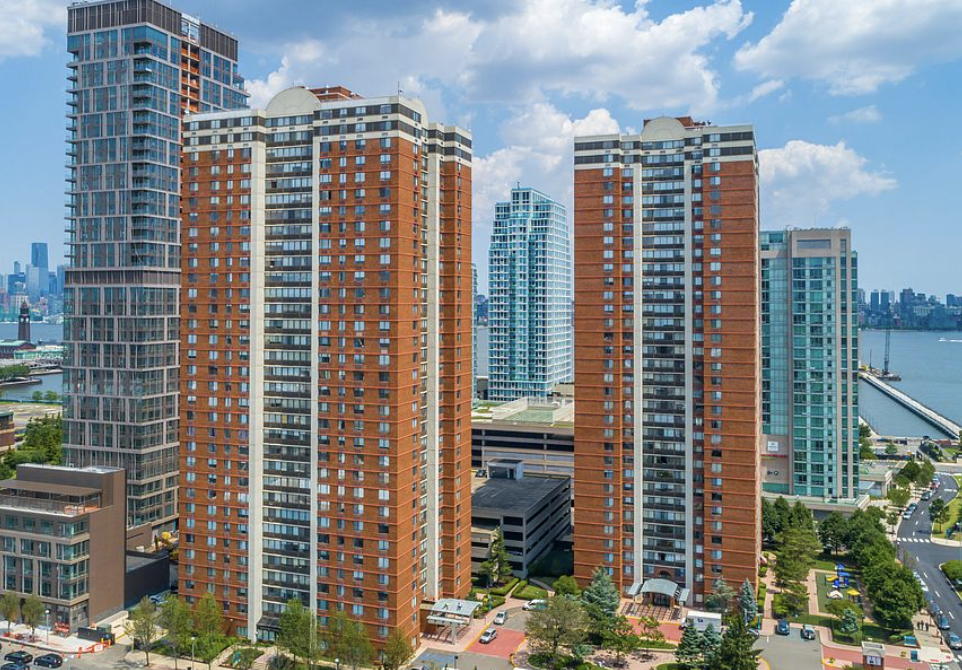
As the city wrestles with a renewed interest in expanding rent control, we revisit the proposed PILOT agreement to preserve and expand affordable housing for low- and moderate-income renters in one of Jersey City’s most well-to-do zip codes. In this article, we compare the costs of rent control, a PILOT agreement, and direct subsidies to help policymakers make more informed decisions on the costs and benefits of each approach. The PILOT, while politically unpopular, might be the cheapest way to achieve an outcome that liberals and progressives alike can agree on.
Newport Presidential Plaza, LeFrak’s two towers at 30 and 40 Newport Parkway, were financed in 1988 with a low-interest, 40-year loan from the New Jersey Housing and Mortgage Finance Agency (NJHMFA). NJHMFA financing comes with a recommended tax abatement, which Jersey City granted in the form of a PILOT agreement. As a condition of the loan, 160 of the 890 apartments, about 18%, were set aside for households earning moderate incomes: up to 80% of Area Median Income (AMI). Rents on those units could only rise with inflation, unless the owner needed more for maintenance, debt service or repair reserves, in which case increases could go as high as 12% (N.J.A.C. 5:80-9.9).
In June 2026, LeFrak paid off the loan two and a half years early. That ends the PILOT, so the towers now pay full conventional property taxes. It also ends the affordability restrictions. LeFrak has told tenants in the 160 affordable units that their next lease will be their last at a below-market rent. According to LeFrak’s op-ed in Hudson County View, tenants still earning under 80% of AMI will get a 3.5% increase on that lease, and higher earners will get increases of 3.6% to 8%. After that, the units go to market rate.
It didn’t have to go this way. In November 2025, the previous City Council voted on Ordinance 25-126, a 30-year PILOT the city’s Housing and Economic Development director Annisia Cialone had negotiated with LeFrak for 30 and 40 Newport Parkway. Most PILOTs go to new construction. This one was designed to keep the existing income-restricted units, add 18 more, and make repairs to the building. Because the towers already exist, state law only allows a new long-term PILOT for “rehabilitation or improvements made in the development or redevelopment of a redevelopment area” (N.J.S.A. 40A:20-12), so state law required the deal pair the affordability terms with a real rehabilitation program.
We supported the PILOT when it came up for a vote, because it was one of the most cost-effective ways to add affordable housing on the table anywhere in the city [Better Blocks NJ]. It would have converted 18 market-rate apartments to affordable units, bringing the complex to 20% affordable. All 18 would have been reserved for households with very low incomes (at or below 30% of AMI), with some rents under $1,000 a month. And as tenants in the existing 80% AMI units moved out, 116 of those apartments would have been re-rented to very-low-income and low-income households (30% or 50% of AMI). Once that turnover had played out many years from now, three-quarters of the affordable units would have served households at or below 50% of AMI, up from none under the old agreement.

Some residents spoke in favor of the PILOT. Others, including the Portside Towers Tenants’ Associations, spoke against it (and got the law around Chapter 260 wrong) [Better Blocks NJ]. At the meeting, LeFrak’s representatives gave no indication that they planned to pay off the mortgage before it matured in 2028. The ordinance failed 1-6-1: Councilman Saleh voted yes, Councilwoman Hulings abstained, and Councilman Solomon (now mayor) was absent. Councilman Gilmore was the only member to explain his no vote. He said PILOT agreements should be reserved for new development, and that with three years left on the mortgage, there was no need to rush. That time ran out early. LeFrak has since paid off the mortgages on two complexes with affordable units, 30 and 40 Newport Parkway and 35 and 55 River Drive South, ending the accompanying PILOT agreements and the affordability restrictions that came with them.
Tenants from both complexes have been coming to council meetings asking the city to act before their rents go to market, which they fear means an increase of roughly 60% to 90%.
Looking back at the ordinance the council rejected shows it was one of the cheapest options available to Jersey City, both for keeping these tenants in their homes and for adding new income-restricted, below-market-rate affordable housing downtown.
What the 2025 PILOT Would Have Paid
The original 1988 PILOT charged 5% of Annual Gross Revenue (“AGR”) for the first ten years, 5.5% for the next ten, and 6% for years 21 through 40. By the end it was paying about $2.13 million a year, roughly $2 million of which went to the city. The 2025 PILOT would have raised the rate from 6% to 10% of AGR for the first ten years, 11% for the next ten, and 12% for the final ten. LeFrak would also have paid a 5% county fee and a 2% administrative fee on top of the gross PILOT payment. Moreover, profits are capped under PILOT agreements per state law; if revenues increase, then Newport must increase its payments under the PILOT agreement.
NW Financial, the city’s financial advisor on the deal, projected a first-year payment (2029) of about $4 million. That is about $1.9 million more than the old PILOT paid, a 93% increase.
Now that the old PILOT is gone, the towers pay conventional taxes. At 2026 rates, after this year’s tax increase, that comes to about $7.2 million a year, with about $2.7 million going to the city. That makes Newport unusual. As we found in July, most expiring PILOT agreements move money from the city to the schools, but here the city collects more under conventional taxes than it did under the old agreement. The 2025 deal would have done better still for the city, at about $4 million a year. The gap between that and the full conventional bill, roughly $3 million in the first year, comes mostly out of what the schools and county would otherwise collect.
The point of the deal was the preservation and expansion of below-market-rate affordable housing for moderate and low-income households. The best way to judge the terms of the deal is by comparing the cost per affordable unit with other recent PILOT agreements. Our method:
- Take what the towers would pay in conventional taxes over 30 years, subtract what they would pay under the PILOT, discount the difference to today’s dollars (net present value or “NPV” terms), and divide by the number of affordable units.
- As in our rent control analysis, we assume market rents grow somewhat faster than inflation while property tax bills grow generally only at the rate of inflation.
- We discount at a 3% real rate.
Unlike our analysis last year, these new estimates use the 2026 tax data, including this year’s tax increase, which raises the conventional baseline and therefore the cost of any PILOT agreement.

Over 30 years, the Newport PILOT would have cost about $276,000 per affordable unit in today’s dollars, compared with about $378,000 for 177 Grand Street, or roughly 27% less. And 177 Grand’s figure assumes that the building would have been built and fully taxed without its PILOT, which is open to debate; Newport’s towers pay full taxes either way. Newport would also have delivered deeper affordability, with more units at or below 50% of AMI than 177 Grand and Canal Crossing combined (134 vs. 133):

We largely left Canal Crossing out of the cost comparison. Affordable units there are largely paid for by state Aspire tax credits (over $490,000 per unit) on top of the PILOT, and the project needs significant infrastructure work to be viable. As a result, a PILOT-only cost per unit wouldn’t be comparable (see our Canal Crossing analysis), but the net present value subsidy of a below-market-rate apartment there is over $1.1 million (four times the cost at Newport and three times the cost at Grand Street) due the lack of infrastructure and prevailing wage requirements.
The main reason Newport gets so much affordability for the money is that the buildings already exist. 177 Grand cost more than $550,000 per unit to build. The Newport deal would have required LeFrak to make upgrades, including new boilers and windows, but that work costs a fraction of new construction.
The Newport PILOT was a missed opportunity last year. It would have kept 160 affordable homes, added 18 more, and made far more of them deeply affordable than any recent new-construction deal has, at a lower cost per unit.

What the Newport PILOT Agreement Left Unresolved
The PILOT wasn’t perfect, and any new version should answer several questions:
- How long would it take for 116 of the 80% AMI units to turn over and convert to 30% and 50% AMI? Tenants in below-market units tend to stay put, so the deeper affordability could take years to arrive.
- What happens to the tenants in those units when the PILOT ends after 30 years? And will the buildings, which would be about 70 years old by then, still be in good shape?
- LeFrak could exit the agreement after year 10. If it did, affordable rents would be frozen for 12 months, capped at 8% a year after that, and converted to market rate as tenants leave.
- 35 and 55 River Drive South would need a PILOT of its own. What would those terms look like?
- Could that second deal include new housing built on top of the complex’s off-site parking structure? That would add homes and tax base and give LeFrak a reason to come back to the table.
The Alternatives

Next to the alternatives, the proposed PILOT agreement holds up much better. The old PILOT ran for 38 years, so neither the county nor the school district has ever collected full taxes from these towers. A new PILOT would not take away revenue they have relied on; it would give up a gain they have only just started to receive. Plus, the schools would still get a share under the administration’s proposed 10% school allocation for PILOTs. The 18 new affordable units would add roughly 8 school-age children, based on Rutgers’ school-age children multipliers, and the school allocation would cover most of that cost. Meanwhile the city’s own revenue from the towers would nearly double compared with the old PILOT, which matters with the city facing a projected $50 million plus budget deficit heading into 2027 [Jersey City Times].
Other options have been floated as potential solutions. Housing vouchers and other direct assistance are popular with economists, because the cost is visible and the help goes to households based on need; vouchers are generally the most efficient form of housing aid. But, critics will note, they don’t add to Jersey City’s stock of affordable homes, and as the numbers below show, keeping these households in place this way would cost more than the PILOT.
What Each Option Would Cost
The council has three ways to keep these households in their homes:
- Revive the PILOT;
- Pass rent control; or
- Pay the difference directly out of the city’s Affordable Housing Trust Fund.
We estimated the 30-year cost of each, using the same assumptions as our rent control analysis: market rents rising 0.5%, 1% or 1.5% a year faster than inflation (our low, middle and high cases), tax bills held at today’s level, and all figures in 2026 dollars discounted at a 3% real rate.
For the PILOT and rent control, the cost is the lost property tax revenue from the towers, which other taxpayers would make up. For direct assistance, it is the gap between market rent and what a household earning 80% of AMI can pay at 30% of its income. We modeled assistance two ways:
- Tied to the apartment, so the next tenant gets it too; and
- Tied to the tenant, so it ends when the household moves.

Cost per home-year divides each option’s 30-year cost by the income-restricted homes it provides each year, both discounted. Rent control reserves no homes by income, so it has no per-home figure. The 80% AMI PILOT is an estimate that assumes LeFrak would accept the same terms, per dollar of rent given up, as in 2025. Assistance matching the PILOT agreement follows the PILOT agreement’s own schedule, with units converting to 30% and 50% AMI as tenants move out.
The PILOT agreement is the cheapest practical way to keep income-restricted homes in these towers: about $14,000 per home per year, compared with about $22,000 to $25,000 for direct assistance at 80% of AMI, and about $33,000 for assistance deep enough to match the PILOT agreement’s mix of 30%, 50% and 80% AMI homes. Assistance that follows the tenant looks cheap in total, at about $19 million, but only because it ends when each household moves. At the 15% annual turnover we used in our rent control analysis, half the households would be gone within about four years, and their apartments would go to market. Direct subsidy costs could vary wildly if those assumptions turn out not to be valid.
Why does direct assistance cost so much more? In the first year, the two cost about the same: roughly $3.4 million in property taxes given up under the PILOT, and about $3.1 million to cover the rent gap for the 160 households. After that, they move in opposite directions. The payments to the city under a PILOT agreement are a share of the building’s rent, which means those payments rise as market rents rise. Indeed, the PILOT agreement’s cost to the public falls to about $1 million a year by year 30.
Direct assistance, on the other hand, pays the difference between market rent and what a household can afford, and with market rents rising faster than incomes in our model, that gap grows to about $5.5 million a year. A PILOT leaves open the risk of rising rents with the landlord; direct assistance foists that risk onto the city. The PILOT also gets more than it pays for. Under the 2025 terms, LeFrak would have given up about $115 million in rent, in today’s dollars, in exchange for about $49 million in tax savings. LeFrak likely receives other benefits too – tax certainty (PILOT agreements are easier to forecast, building repairs, and goodwill with the municipal government). A rent subsidy has to pay the landlord the full market rent and a negotiated PILOT agreement for income-restricted affordable housing doesn’t.

One caveat cuts the other way. Our figures use NW Financial’s market rent estimates. If these older apartments would actually rent for 20% less, direct assistance tied to the apartment would cost about $48 million, roughly the same as the PILOT, though it would still reach only households at 80% of AMI.
A slimmer deal is also possible. If the city negotiated a PILOT that kept only today’s 160 homes at 80% of AMI, and LeFrak accepted the same tax break per dollar of rent given up as in 2025, it would cost about $34 million, the equivalent of raising the PILOT rate by about two percentage points in every year. That is the cheapest option per home, at about $11,000 a year. But it drops the 18 new homes and all 134 homes at 30% and 50% of AMI. Households earning 80% of AMI are the closest to affording market rent, and the deeper units are where public money does the most good to help low-income households. Whether LeFrak would take those terms is an open question but it goes contrary to Mayor Solomon’s promise for $1,000 rents, which only exist for households at 30% AMI.
The impact of rent control on these two towers alone (note: such specific targeting is not possible with rent control) would cost about as much as the PILOT agreement in our middle case, roughly $53 million in lost tax revenue over 30 years, with less in the lowercase and more in the high case.

Rent control would help far fewer low-income households obtain new housing. Rent control has no income test, so the benefit is spread across all 890 households, most of whom pay market rent and have household incomes far above median income. Moreover, under rent control, no apartments would be reserved for the very low and low-income households the PILOT would serve. By 2056, the cost of rent control on the building will reach about $3.8 million a year and continue growing in perpetuity (the quality of housing would deteriorate over that time, too). Therefore, the ordinance would cover about 210 buildings (most of which have no income-restricted affordable housing whatsoever). As we found in October, it could likely take about $25 million a year off the tax rolls at first, rising to $59 million by 2036. Over 30 years, that adds up to about $1.7 billion in today’s dollars in our middle case, and between $0.6 billion and $2.4 billion across our low and high cases.

The divergence is starkest for the city’s own budget. Because the PILOT pays the city more than ordinary taxes would, the city comes out about $36 million ahead over 30 years, or about $28 million with the proposed 10% school allocation; the lost school and county tax revenue is shifted to the taxpayers. Rent control ends up as a very blunt instrument with astronomical costs over a 30-year period. Direct assistance would come entirely from city-controlled funds: about $80 million for assistance tied to the apartment or $19 million for assistance to the affected tenants.
The Portside rent control activists are pushing for rent control instead after advocating against the PILOT agreement that would have helped the Newport renters. Democratic Socialists on the city council, led by Councilwoman Little and Councilman Ephros, have proposed an ordinance that would end the rent control exemption for 30-year-old buildings in redevelopment areas, which would cover Newport Presidential Plaza. We explained in October why that would be a costly mistake: it would cut the city’s tax base, and the lost revenue would be passed on as higher taxes and rents to every building the ordinance doesn’t cover. Councilwoman Little has disputed some of the analysis circulating online, but she curiously has not provided any analytical or economic evidence contesting mainstream claims about rent control. The difference in paperwork is stark between the different proposals. The Newport PILOT, a deal worth about $4 million a year, came with roughly 92 pages of supporting documentation and financial analysis. The rent control ordinance, which would likely cost the city far more money in lost revenue and tax distortions, is four pages long: the text of the ordinance and nothing else.
It’s like déjà vu all over again
This isn’t the first time the two causes have collided. In 2019, the council postponed a vote on ending the same redevelopment-area exemption and tabled abatements LeFrak had requested to rehabilitate four Newport towers and add almost 30 affordable units. Rent control lowers the value of the buildings it covers, and with it their tax assessments.
After St. Paul, Minnesota adopted rent control in 2021, property values fell by roughly 4% to 7%, and apartment buildings with eight or more units lost 13.7% of their value relative to comparable areas (Ahern and Giacoletti). Our conservative estimate is that by 2028, the ordinance would cost the city more in lost tax revenue than 30 and 40 Newport Parkway pay in conventional taxes in total. As more buildings pass the 30-year mark, that loss would keep growing.
Either way, LeFrak ends up paying the city less than full conventional taxes. Under the PILOT, though, the building’s profits would be capped, and the city would get 178 regulated affordable units in return. Rent control would cost the city more and guarantee much less in the way of “affordable housing.”
The bigger cost of rent control would fall on all current residents and hurt working and middle-class households most of all. New construction is the main way new income-restricted affordable housing and below-market-rate rentals get built in Jersey City. Developers working with limited capital and high interest rates would put their money elsewhere in the region. Fewer new buildings will mean less affordability and higher rents in the remaining market-rate rentals. Rent control on waterfront towers would be a lottery ticket that pays out mostly to Jersey City’s highest earners rather than a below-market-rate rental opportunity reserved for low-income households. It would help the wealthier tenants who already live in those towers most of all. Renters and homeowners in the Heights, Bergen-Lafayette and Greenville would pay for it in higher rents as demand spills into their neighborhoods, higher taxes as landlords pass along the city’s lost revenue, and less new housing overall.

Neither vouchers nor rent control would do what this PILOT does, which is create deeply affordable housing down to 30% of area median income. The 2025 deal would have produced more units at or below 50% of AMI than Canal Crossing and 177 Grand combined, at a lower cost per unit than 177 Grand, while increasing the city’s own revenue from the towers.
Some in the Solomon administration seem open to entering into a new PILOT agreement with LeFrak and pushing for a better deal where it can. Our recommendation is to look at converting some of the off-site parking at River Drive South into more housing to reduce the burden on the budget. More broadly, the Newport numbers suggest the city would in general be better served by entering into similar PILOT agreements to other existing buildings in exchange for deep, long-term affordability as it seems to be one of the cheapest tools Jersey City has to create deeply affordable below-market rentals.
Editor’s Note: A representative of the LeFrak organization reached out after the publication of this article to confirm that below-market-rate units will not transition to market-rate immediately. “It will transition to market over time for incumbent tenants being mindful of unconscionability case law,” said Charles Burton of the LeFrak organization.
2 responses to “A New Deal for Newport Residents”
This is a Graduate School thesis
That’s part of the problem — we are forced to be exacting with facts and data “to show our work” that the pro-rent-control-expansion side’s claims of “rent control is affordable housing” are spurious.